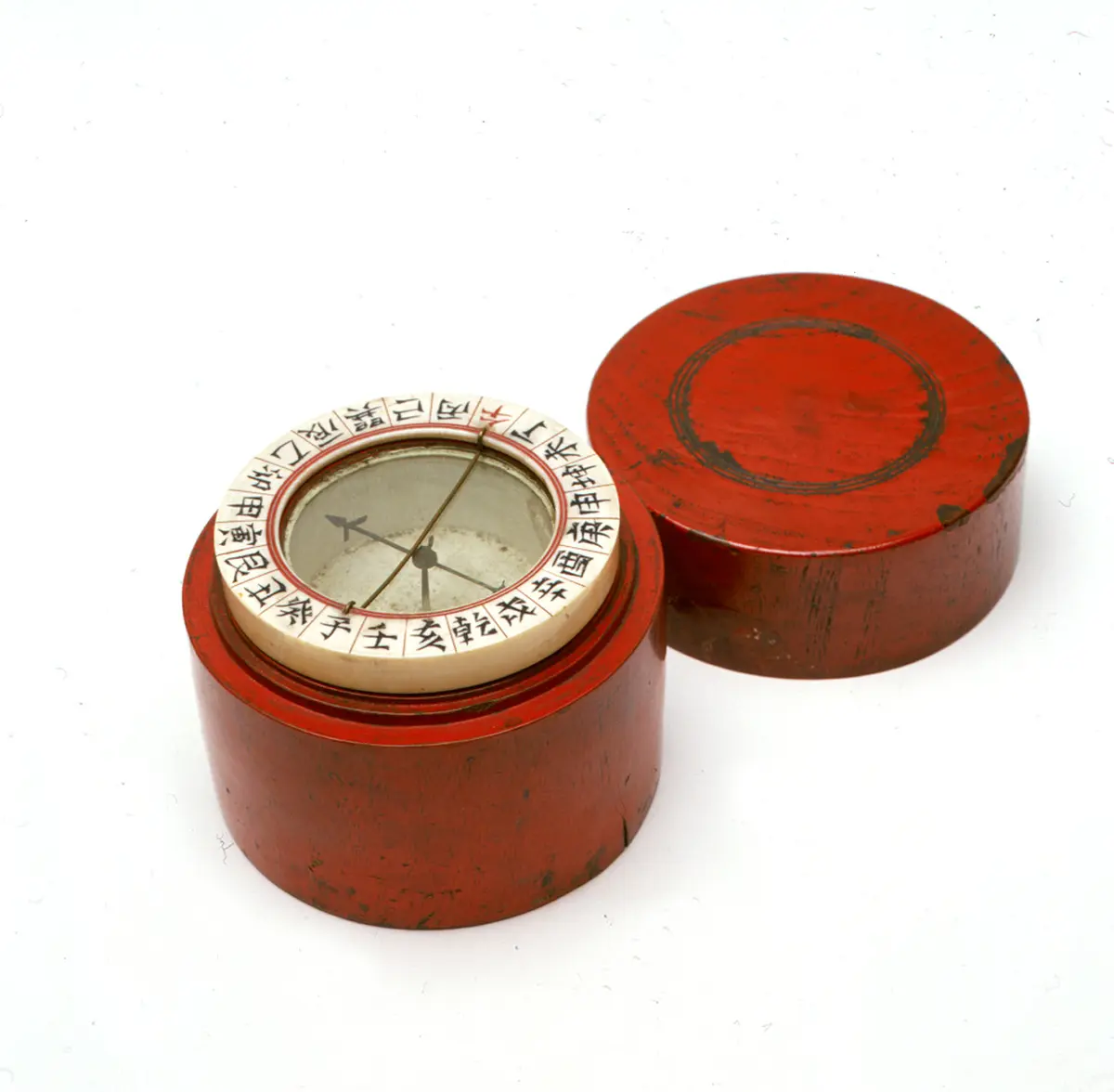
The magnetic compass is used at sea
“By about 1100 Chinese pilots steered by a magnetised 'south-pointing needle' in cloudy weather; within a century European sailors were floating magnetised needles too.”
Around the year 1100 Chinese sailors began to steer by a magnetised needle when clouds hid the sun and the stars. The first record of it is in the 'Pingzhou Table Talk' of Zhu Yu, written between 1111 and 1117, about the big merchant ships of Guangzhou (Canton), where his father had served at the port from 1094: the pilots knew the coasts, steered by the stars at night and by the sun in the day, and in dark weather looked at the 'south-pointing needle'. Within about a century sailors in the Mediterranean were doing the same, and by the middle of the thirteenth century so were captains in the Arab and Persian seas.
The Chinese had known for a long time that lodestone, a natural magnetic iron ore, pulls iron: a book of the late third century BCE already says so. A Han writer of 83 CE mentions a 'south-pointing spoon', and in 1948 the scholar Wang Zhenduo explained it as a spoon carved from lodestone that turned on the bronze board of a fortune-teller. His model is famous, but it is a modern reconstruction: no such spoon has ever been found. The firm evidence comes later. A military handbook finished in 1044, the Wujing zongyao, tells armies lost in dark weather to float a thin iron 'fish', heated red-hot and cooled pointing north, in a bowl of water, so that its head points south. About 1088 the scholar Shen Kuo described a needle rubbed on lodestone, hung from a single silk thread, and noticed that it points a little east of true south: the first clear description of the needle compass, and of magnetic declination, in any language.
At sea the needle was at first simply floated on water. When the envoy Xu Jing sailed to Korea in 1123 with a convoy of eight ships, his pilots steered by the stars and the Great Bear, and on overcast nights by a 'south-pointing floating needle'. In Europe the English scholar Alexander Neckam wrote about 1190 that sailors in cloudy weather or at night touch a needle to the magnet, and it turns until its point looks north. Guyot de Provins, about 1205, described a needle stuck through a straw and floated in water, with a lamp lit beside it at night, and Jacques de Vitry, writing in the Holy Land about 1218, called it 'very necessary' for seafarers. A Persian book of about 1232 tells of a captain who floated a fish-shaped iron rubbed with a magnet, and an Arabic writer saw a floating needle used at sea in 1242. In August 1269, in the camp of the French army besieging Lucera in southern Italy, Petrus Peregrinus finished a letter on the magnet that described a needle on a pivot inside a box marked with degrees, the instrument that later sailors used.
Nobody knows whether Europe learned of the compass from China, through the Indian Ocean trade, or found it again on its own: the European texts are a century later than the Chinese ones, but no source tells of the journey between them, and Britannica calls the two discoveries apparently independent. The old story that a sailor of Amalfi called Flavio Gioia invented the compass about 1300 is a legend; at most it remembers an Italian improvement of that time, the card with the points of the wind fixed under the needle. The Chinese kept the floating needle until the sixteenth century, when the dry, pivoted compass reached them from Japanese ships.
The compass let ships hold a course under grey skies and on dark nights instead of waiting for the sun or the Pole Star. In the Mediterranean, pilots drew sea charts covered with lines of direction, of which the Carta Pisana of the late thirteenth century is the oldest to survive. Two centuries later the long voyages of the Chinese and the European fleets depended on it, and every ship still carries one, if only as the back-up to satellite navigation. Shen Kuo's remark that the needle does not point exactly south was also the start of the study of the Earth's magnetism.
What happened
- 1044
The Wujing zongyao, a handbook of war compiled under Zeng Gongliang at the Song court, is finished. It tells armies lost in dark weather to float a 'south-pointing fish' of thin iron, heated red-hot and cooled pointing north, in a bowl of water, so that its head turns south.
Kaifeng (Bianjing), the Northern Song capital, where the court's military handbook Wujing zongyao, with its floating 'south-pointing fish', was finished in 1044 - 1088
About this year the scholar Shen Kuo writes in his Dream Pool Essays that a needle rubbed on lodestone points south, but always a little to the east, and that it works best hung from a single silk thread: the first clear description of the needle compass and of magnetic declination.
- 1094
Zhu Fu takes up a high post at the port of Guangzhou (Canton), and from 1099 to 1102 he governs the city. His son Zhu Yu will later write down what he learned there about the port's sea-going ships.
Guangzhou (Canton), the great Song port for the southern seas: Zhu Yu's father served at its port from 1094, and Zhu Yu described its ships and their pilots' south-pointing needle; marked at the old Huaisheng mosque - 1111
Between 1111 and 1117 Zhu Yu writes the Pingzhou Table Talk. On the big ships of Guangzhou, which carry up to several hundred men, the pilots steer by the stars at night and the sun by day, and in dark weather they look at the south-pointing needle: the first record of the compass used at sea.
Guangzhou (Canton), the great Song port for the southern seas: Zhu Yu's father served at its port from 1094, and Zhu Yu described its ships and their pilots' south-pointing needle; marked at the old Huaisheng mosque - 1116
The pharmacologist Kou Zongshi describes a needle rubbed on lodestone, hung from a silk fibre or floated on a piece of rush pith, and notes that it always points a little east of south, towards the compass point Bing, about 15 degrees off.
- 1123
A Song embassy sails to Korea in a convoy of eight ships. Its member Xu Jing writes in his account of 1124 that the pilot steers by the stars and the Great Bear, and on overcast nights by the 'south-pointing floating needle'.
- 1190
About this year the English scholar Alexander Neckam writes in his De naturis rerum that sailors who cannot see the sun or the stars touch a needle to the magnet, and it turns until its point looks north: the first mention of the compass in Europe.
St Albans, home town of Alexander Neckam (born 1157), who about 1190 wrote the first European description of sailors steering by a magnetised needle - 1205
About this year the French poet Guyot de Provins describes, in his satire La Bible, how sailors touch a needle to 'an ugly brown stone', stick it through a straw, float it in water, and at night light a lamp to watch it point to the Pole Star.
- 1218
Jacques de Vitry, bishop of Acre, writes in his history of the East that an iron needle touched by the lodestone turns towards the north star and is 'very necessary' for those who sail the seas.
- 1232
About this year Muhammad al-Awfi, in a Persian collection of stories, tells of sailors who find their way with a fish-shaped piece of iron rubbed with a magnet and floated on water: the earliest mention of the compass in the Islamic world.
- 1242
The writer Baylak al-Qibjaqi watches a floating compass needle being used on a ship; in his book of 1282 on precious stones he describes it, and adds that the captains of the Indian Ocean use a floating fish-shaped iron leaf.
- 1269
In the French camp besieging Lucera, Petrus Peregrinus finishes his Letter on the Magnet. He explains the poles of the lodestone, and describes a floating compass and a needle on an axis in a covered box divided into degrees, by which a ship can steer for any port.
The fortress of Lucera in Apulia: Petrus Peregrinus finished his letter on the magnet, with the first description of a pivoted compass, in the siege camp here on 8 August 1269