UTC replaces Greenwich Mean Time
“On 1 January 1972 world time passed from the Sun over Greenwich to caesium clocks: UTC ticks at the atomic second and adds leap seconds (27 so far, the last in 2016), which stop on 20 May 2027.”
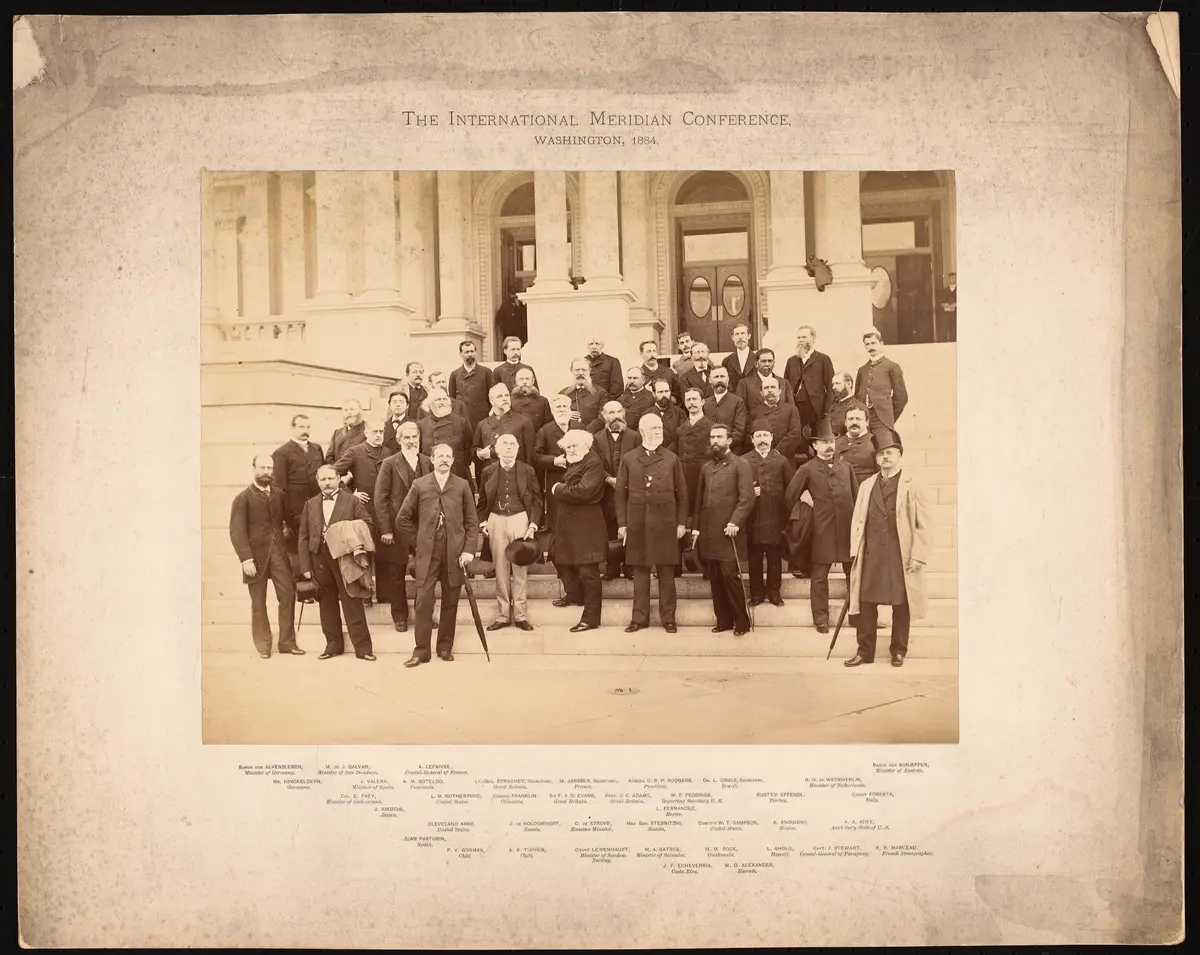
On 1 January 1972, at 00:00:00 UTC, the world's official time changed its engine. For almost a century the reference had been Greenwich Mean Time (GMT): clock time worked out from the average position of the Sun over the Royal Observatory at Greenwich, a standard that Britain made law in 1880 and that the 1884 Washington conference recommended to the world. From that New Year's Day the reference was Coordinated Universal Time (UTC): a count of seconds from caesium atomic clocks, every second exactly the same length, with a whole extra second slipped in now and then to keep the count within 0.9 seconds of the Earth's turning. Nobody's day changed. UTC and GMT still show the same hour and minute, which is why Britain's winter time is still called GMT.
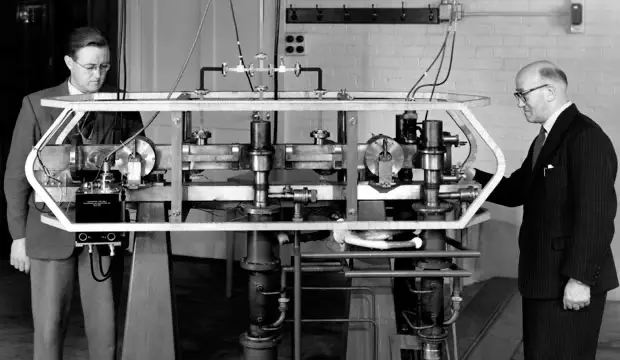
The reason was that the Earth is a poor clock. Its spin speeds up and slows down by small, unpredictable amounts (tides, the atmosphere and movements inside the planet all play a part), so the old second, one 86,400th of a mean solar day, could not be fixed exactly. In 1955 Louis Essen and Jack Parry brought a caesium clock into use at the National Physical Laboratory in Teddington, near London. Over the next years its beat was compared with the Moon-based astronomical second measured at the US Naval Observatory by William Markowitz and R. Glenn Hall, and their joint paper of 1958 put the frequency of caesium at 9,192,631,770 cycles a second. In October 1967 the General Conference on Weights and Measures defined the second as exactly that many periods of the atom's radiation. Time was now tied to an atom, not to the sky.
But sailors, astronomers and surveyors still needed a time that followed the Earth, and radio stations could broadcast only one signal for everybody. From 1960 the British and American time services began to coordinate their broadcasts, and from 1961 the Bureau International de l'Heure (BIH), working at the Paris Observatory, kept the shared scale called UTC. Its answer was a "rubber second": the atomic seconds were deliberately stretched by 1.5 to 3 parts in a hundred million, with the stretch changed at the start of some years (it was 150, 130, 150 and then 300 parts in ten thousand million between 1961 and 1966), and the clocks were jumped by 50 or 100 milliseconds, several times a year in the mid-1960s. By the end of 1971 UTC ran about 9.9 seconds behind atomic time. Time laboratories disliked it: a second on the radio was not a true second, and every transmitter used slightly different settings.
In 1970 the radio engineers' committee (the CCIR) agreed a simpler rule, its Recommendation 460, and it took effect on 1 January 1972. From that moment a UTC second was the exact atomic second, and UTC was set exactly 10 seconds behind International Atomic Time (TAI), after one last step of 0.107758 seconds. The only later adjustments would be whole leap seconds, normally added at the end of 30 June or 31 December, which the International Earth Rotation and Reference Systems Service (IERS) decides from measurements of the Earth's rotation. The first came at the end of 30 June 1972. There have been 27 in all, the last at the end of 2016, so TAI is now 37 seconds ahead of UTC. The BIH's work on atomic time passed to the International Bureau of Weights and Measures (BIPM) on 1 January 1988.
The fix solved one problem and made another. A minute of 61 seconds breaks software that assumes every minute has 60, and computers, telecom networks and satellite systems each handle the extra second in a different way. The Earth has also lately been spinning a little faster, and in March 2025 experts at a BIPM and IERS workshop judged that the chance of a first negative leap second, a second taken away, could reach 30 percent by 2035. In 2022 the General Conference decided to widen the allowed gap between UTC and the Earth's time in or before 2035. On 15 October 2026, at Versailles, its 28th meeting fixed the date: from 20 May 2027 UTC will run without leap seconds, and the gap may grow to 3,600 seconds. The system begun in 1972 ends after 55 years.
What happened
- 1955
The first caesium clock built by Louis Essen and Jack Parry goes into operation at the National Physical Laboratory in Teddington. From June 1955 its time and frequency are compared with the US Naval Observatory's. NPL says only 'in 1955'; the month is from the Nature letter of 1958 and from later accounts.
National Physical Laboratory, Teddington, where Essen and Parry built the caesium clock- 1958
Markowitz and Hall at the US Naval Observatory and Essen and Parry at NPL publish, in Physical Review Letters, the frequency of caesium in terms of the astronomers' Ephemeris second: 9,192,631,770 cycles a second. It is the first link between atomic time and the Moon's motion, and the number the 1967 definition would use.
US Naval Observatory, Washington, D.C.- 1960
The British and American national time services begin to coordinate the offsets of their radio time signals so that both follow Earth time (UT2) closely: the seed of 'Coordinated Universal Time'.
The 11th General Conference on Weights and Measures (11-20 October 1960) ratifies the ephemeris second, 1/31,556,925.9747 of the tropical year 1900: the last second defined by the sky.
Pavillon de Breteuil, Saint-Cloud: the International Bureau of Weights and Measures- 1961
- 12:00 a.m.
The Bureau International de l'Heure begins to coordinate UTC: atomic seconds deliberately stretched by 150 parts in ten thousand million (1.5 parts in a hundred million) so that the broadcast time follows the Earth. This is the 'rubber second'.
Paris Observatory: the Bureau International de l'Heure and, today, the IERS Earth Orientation Centre The first jump: UTC is stepped by 50 milliseconds to stay near Earth time.
Paris Observatory: the Bureau International de l'Heure and, today, the IERS Earth Orientation Centre- 1966
The stretch of the UTC second is set to its largest value, 300 parts in ten thousand million (3 parts in a hundred million), and kept until the end of 1971; the seven jumps of 1963-65 are behind it.
Paris Observatory: the Bureau International de l'Heure and, today, the IERS Earth Orientation Centre- 1967
- 9:00 p.m.
The US stations WWV and WWVH switch their voice announcements from local time to 'GMT': the name that the public heard in the 1960s was attached to the stretched-second UTC, not to true Greenwich Mean Time.
WWV time-signal station, Fort Collins, Colorado At its 13th meeting (10-16 October 1967) the General Conference on Weights and Measures defines the second as 9,192,631,770 periods of the radiation of the caesium-133 atom, replacing the 1960 definition from the Earth's orbit. UTC's rubber second is now stretched from a true unit.
Pavillon de Breteuil, Saint-Cloud: the International Bureau of Weights and Measures- 1968
The last 100 millisecond step of the old system (+0.1 s): the stretch stays at 300 parts in ten thousand million for another four years.
Paris Observatory: the Bureau International de l'Heure and, today, the IERS Earth Orientation Centre- 1970
The radio engineers' committee, the CCIR, agrees the new rule of Recommendation 460: UTC will run at the exact atomic rate and be kept near Earth time by whole leap seconds, from 1 January 1972. The same year the committee on atomic time asks the BIH to make International Atomic Time (TAI).
Paris Observatory: the Bureau International de l'Heure and, today, the IERS Earth Orientation CentreAt Herstmonceux the Royal Greenwich Observatory installs atomic-clock equipment for the Greenwich Time Service, replacing the quartz oscillators of 1949 that had replaced Shortt's pendulum clocks of 1924; it feeds the BBC's pips by wire for twenty years.
Herstmonceux Castle, Sussex, home of the Royal Greenwich Observatory from 1948- 1972
- 12:00 a.m.
At 00:00:00 UTC the new UTC begins. The old scale is set back 0.107758 seconds, and UTC is now exactly 10 seconds behind International Atomic Time, with seconds the same length as atomic seconds. The old rubber-second UTC had by then fallen 9.89 seconds behind. The US and UK radio time signals make the same change on the same day.
Paris Observatory: the Bureau International de l'Heure and, today, the IERS Earth Orientation Centre - 11:59 p.m.
The first leap second is added: after 23:59:59 on 30 June 1972 comes 23:59:60, and TAI-UTC becomes 11 seconds.
Paris Observatory: the Bureau International de l'Heure and, today, the IERS Earth Orientation Centre - 1974
The US stations WWV and WWVH stop saying 'GMT' and begin to announce the time scale as 'UTC'. Britain's civil time keeps the name GMT.
WWV time-signal station, Fort Collins, Colorado- 1988
The International Earth Rotation Service begins work, and responsibility for International Atomic Time passes from the BIH, at the Paris Observatory, to the BIPM. Bernard Guinot, who directed the BIH from 1965 to 1985, hands the work over.
Pavillon de Breteuil, Saint-Cloud: the International Bureau of Weights and Measures- 2016
- 11:59 p.m.
The 27th and last leap second to date is added at the end of the day: 23:59:60 UTC, which NASA marks with an illustration; TAI-UTC becomes 37 seconds.
Paris Observatory: the Bureau International de l'Heure and, today, the IERS Earth Orientation Centre - 2022
The 27th General Conference on Weights and Measures (15-18 November 2022) decides that the maximum gap between UTC and Earth-rotation time (UT1) 'will be increased in, or before, 2035', pointing to the problems that leap seconds cause digital networks and satellite systems and the possible need for a first negative leap second.
- 2025
A workshop of the BIPM's time committee and the IERS, which includes experts on Earth rotation, estimates that the chance of a negative leap second will rise to 30 percent by 2035. No negative leap second has ever been made, and the industries that rely on timing are largely unprepared.
- 2026
At its 28th meeting, held 13-15 October 2026 at Versailles, the General Conference on Weights and Measures adopts Resolution 5: continuous UTC, with no leap seconds, takes effect on 20 May 2027, and the gap between UTC and UT1 may grow to 3,600 seconds. The vote was taken on the last day of the meeting; the official text is the French one.
Palais des Congres, Versailles, where the 28th General Conference on Weights and Measures voted in October 2026