Benjamin Franklin
“The Philadelphia printer whose experiments showed that lightning is electricity and who invented the lightning rod; as a founding father he won France's alliance and helped make the peace of 1783.”
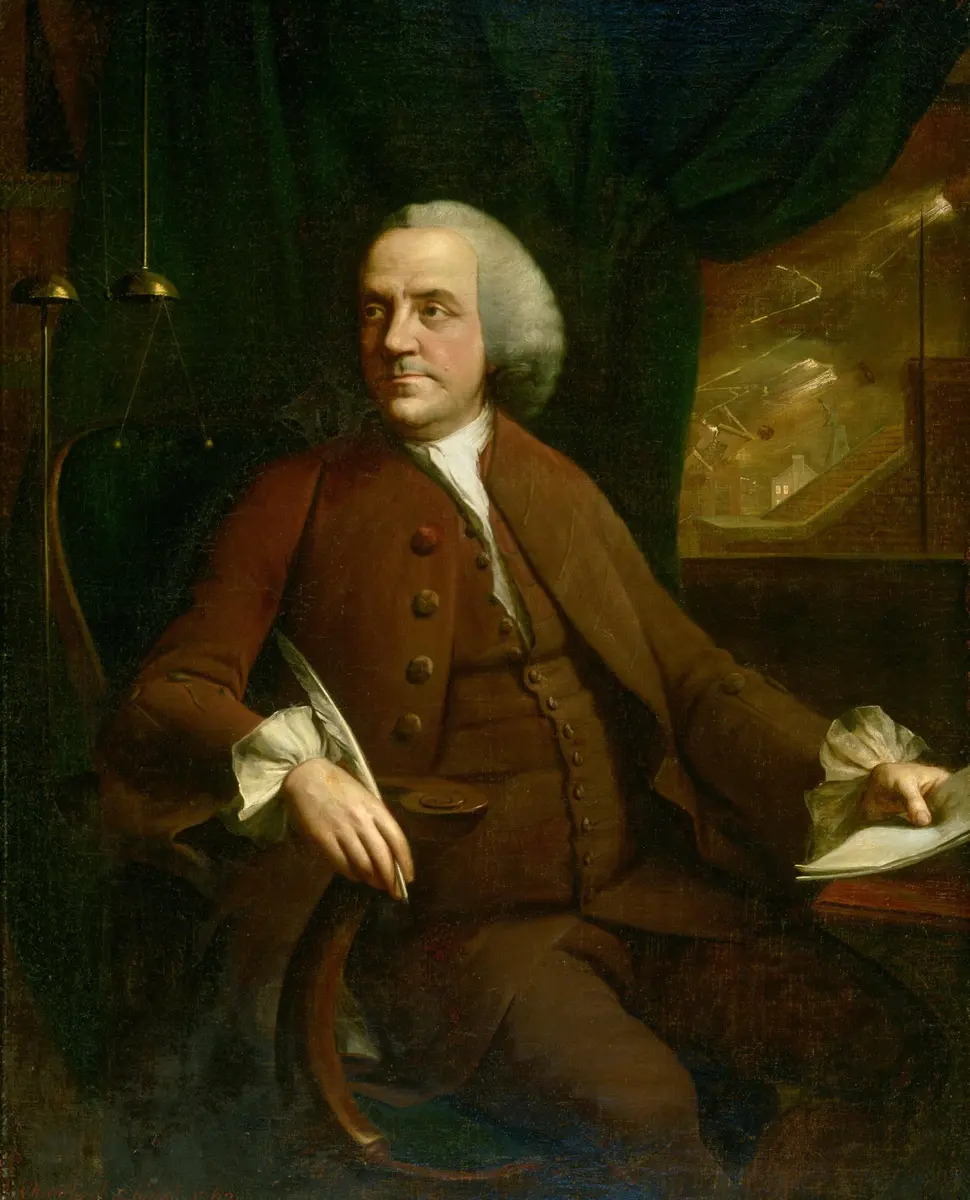
Benjamin Franklin was the Philadelphia printer who became the most famous American scientist of his century and then one of the founders of the United States. In a few years of experiments, from 1746 to 1752, he gave the young science of electricity much of its modern shape. He described electricity as a single 'fluid' that a body can have too much or too little of, and named the two states positive and negative, or plus and minus; he saw that the charge gained in one place always equals the charge lost in another, the rule now called the conservation of charge; he coined words such as battery, conductor and charge; and he proposed the experiment that proved lightning is electricity. His pointed, grounded lightning rod was soon protecting buildings in America and Europe.
He was born in Boston on 17 January 1706 (6 January by the Old Style calendar still used in Britain and its colonies), the tenth son of a soap and candle maker, and left school at ten. Apprenticed at twelve to his brother James, a printer, he taught himself to write by copying essays, and at sixteen slipped fourteen letters under the door of James's newspaper in the voice of 'Silence Dogood', a middle-aged woman. At seventeen he ran away to Philadelphia. By 1730 he had his own printing house and the Pennsylvania Gazette, and from 1732 he wrote Poor Richard's almanac, whose sayings about hard work and thrift are still quoted. He took Deborah Read as his common-law wife and raised William, his son by an unknown mother. With his discussion club, the Junto, he founded a subscription library, a fire company, the American Philosophical Society and the academy that became the University of Pennsylvania, and at 42 he was rich enough to retire.
Electricity was the 'philosophical amusement' of his retirement. His letters to Peter Collinson in London were printed there in 1751 as Experiments and Observations on Electricity, which went through many editions in four languages. In May 1752 his French translator, Thomas-François Dalibard, had his proposed experiment carried out at Marly, near Paris, drawing sparks from a thundercloud down a tall iron rod; in June, by a later account, Franklin did the same in Philadelphia with a kite and a key. He never claimed to have been first and never described the day himself, so some writers doubt that the kite flew at all, though the editors of his papers see no good reason to. The Royal Society gave him its Copley Medal in 1753. His stove, his glass armonica, the bifocal spectacles he is credited with and his chart of the Gulf Stream showed the same practical curiosity, and he patented none of them.
From 1757 he lived mostly in London, at 36 Craven Street, as agent for Pennsylvania, a loyal subject who hoped to rise in the British Empire. The Stamp Act crisis and his public humiliation before the Privy Council in January 1774, over leaked letters of Massachusetts's governor Thomas Hutchinson, turned him into a revolutionary. Back in Philadelphia in 1775, he sat in the Continental Congress and on the committee that drafted the Declaration of Independence. At the end of 1776 Congress sent him to France, where, in a fur cap and plain brown suit, he became a celebrity; from his house at Passy he won the French alliance of February 1778 and, with John Adams and John Jay, made the Treaty of Paris of 1783, by which Britain recognised American independence.
He came home in 1785, served three years as President of Pennsylvania, and at 81 was the oldest member of the Constitutional Convention of 1787, where he urged the delegates to sign. He had owned enslaved people for decades and his newspaper printed advertisements for slave sales, but late in life he turned against slavery: in 1787 he became president of Pennsylvania's abolition society, and in February 1790 he petitioned Congress to end it. He died at home in Philadelphia on 17 April 1790, aged 84, and was buried beside Deborah in Christ Church Burial Ground. His Autobiography, begun in England in 1771, unfinished and published after his death, made him the model of the self-made American.
What happened
- 1706
Benjamin Franklin is born in Boston, in a house on Milk Street, the tenth son among the seventeen children of Josiah Franklin, a soap and candle maker; the calendar of the time calls the day 6 January 1705/6. He is baptised by the congregation of the Old South Meeting House across the street.
Milk Street, Boston, opposite the Old South Meeting House: the house where Franklin was born on 17 January 1706 stood here until it burned in 1810- 1718
His schooling over at ten, he is apprenticed at twelve to his brother James, a printer. He masters the trade and teaches himself to write by copying and rewriting the essays of The Spectator.
Milk Street, Boston, opposite the Old South Meeting House: the house where Franklin was born on 17 January 1706 stood here until it burned in 1810 - 1722
James's New-England Courant prints a letter from 'Silence Dogood', a middle-aged woman of his invention, which the sixteen-year-old apprentice had slipped under the printing-house door at night. Thirteen more follow, mocking Harvard students and funeral elegies, before he reveals that he wrote them.
Milk Street, Boston, opposite the Old South Meeting House: the house where Franklin was born on 17 January 1706 stood here until it burned in 1810- 1723
After a quarrel with James he breaks his apprenticeship, finds no work in New York and goes on to Philadelphia, where he lands on a Sunday morning, tired and hungry, and walks up Market Street eating one of three 'great Puffy Rolls' past the door of Deborah Read. He soon finds work with the printer Samuel Keimer.
Franklin Court, off Market Street, Philadelphia: the house he had built while in London and lived in after 1785, where he died on 17 April 1790; Philadelphia was his home from 1723 - 1724
Promised letters of credit by Pennsylvania's governor, Sir William Keith, he sails for London to buy type and press; the letters never come, so he works there for nearly two years in London printing houses.
- 1726
He returns to Philadelphia as clerk to the merchant Thomas Denham, and after Denham's death goes back to printing.
Franklin Court, off Market Street, Philadelphia: the house he had built while in London and lived in after 1785, where he died on 17 April 1790; Philadelphia was his home from 1723 - 1727
He founds the Junto, or Leather Apron Club, a club of young tradesmen who meet to debate morals, politics and natural philosophy; from it will come Philadelphia's library, its fire company and a city watch.
Franklin Court, off Market Street, Philadelphia: the house he had built while in London and lived in after 1785, where he died on 17 April 1790; Philadelphia was his home from 1723 - 1729
With a partner he has opened his own printing house; now he takes over the Pennsylvania Gazette, which becomes one of the best colonial newspapers, and wins the printing of the colony's paper money after writing A Modest Enquiry into the Nature and Necessity of a Paper Currency.
Franklin Court, off Market Street, Philadelphia: the house he had built while in London and lived in after 1785, where he died on 17 April 1790; Philadelphia was his home from 1723 - 1730
He 'took her to Wife': Deborah Read, whose first husband had deserted her, becomes his common-law wife. They raise William, his son by a woman never identified, and have a son, Franky, who dies at four, and a daughter, Sarah.
Franklin Court, off Market Street, Philadelphia: the house he had built while in London and lived in after 1785, where he died on 17 April 1790; Philadelphia was his home from 1723- 1731
Because the Junto's members need books, he organises the Library Company of Philadelphia, a subscription library.
Franklin Court, off Market Street, Philadelphia: the house he had built while in London and lived in after 1785, where he died on 17 April 1790; Philadelphia was his home from 1723 - 1732
His Gazette advertises the first Poor Richard's Almanack, for 1733, as 'just published', written under the name of the stargazer 'Richard Saunders'. It appears every year until the edition for 1758, full of proverbs about work and thrift.
Franklin Court, off Market Street, Philadelphia: the house he had built while in London and lived in after 1785, where he died on 17 April 1790; Philadelphia was his home from 1723- 1737
Clerk of the Pennsylvania Assembly since 1736, he is made postmaster of Philadelphia.
Franklin Court, off Market Street, Philadelphia: the house he had built while in London and lived in after 1785, where he died on 17 April 1790; Philadelphia was his home from 1723 - 1743
He proposes an intercolonial society for 'promoting useful knowledge', the beginning of the American Philosophical Society, the oldest learned society in the United States.
Franklin Court, off Market Street, Philadelphia: the house he had built while in London and lived in after 1785, where he died on 17 April 1790; Philadelphia was his home from 1723 - 1744
His pamphlet on the 'New Invented Pennsylvanian Fire-Places', the iron stove he had designed some years before and advertised since December 1741, is announced as just published. He turns down the governor's offer of a patent: as we enjoy others' inventions, he says, we should share ours freely.
Franklin Court, off Market Street, Philadelphia: the house he had built while in London and lived in after 1785, where he died on 17 April 1790; Philadelphia was his home from 1723- 1746
With electrical apparatus sent to the Library Company by Peter Collinson, his Quaker correspondent in London, Franklin and three friends begin, in the winter of 1746–47, to experiment with electricity.
Franklin Court, off Market Street, Philadelphia: the house he had built while in London and lived in after 1785, where he died on 17 April 1790; Philadelphia was his home from 1723 - 1747
In a letter to Collinson he explains the 'new terms among us': a body is 'electrised positively' or 'negatively', plus or minus, because electricity is a single fluid that one body gains as another loses, and the two amounts are always equal.
Franklin Court, off Market Street, Philadelphia: the house he had built while in London and lived in after 1785, where he died on 17 April 1790; Philadelphia was his home from 1723- 1748
At 42 he retires from business as a silent partner in the firm of Franklin and Hall, to live as a gentleman and give his time to 'Philosophical Studies and Amusements'.
Franklin Court, off Market Street, Philadelphia: the house he had built while in London and lived in after 1785, where he died on 17 April 1790; Philadelphia was his home from 1723 - 1749
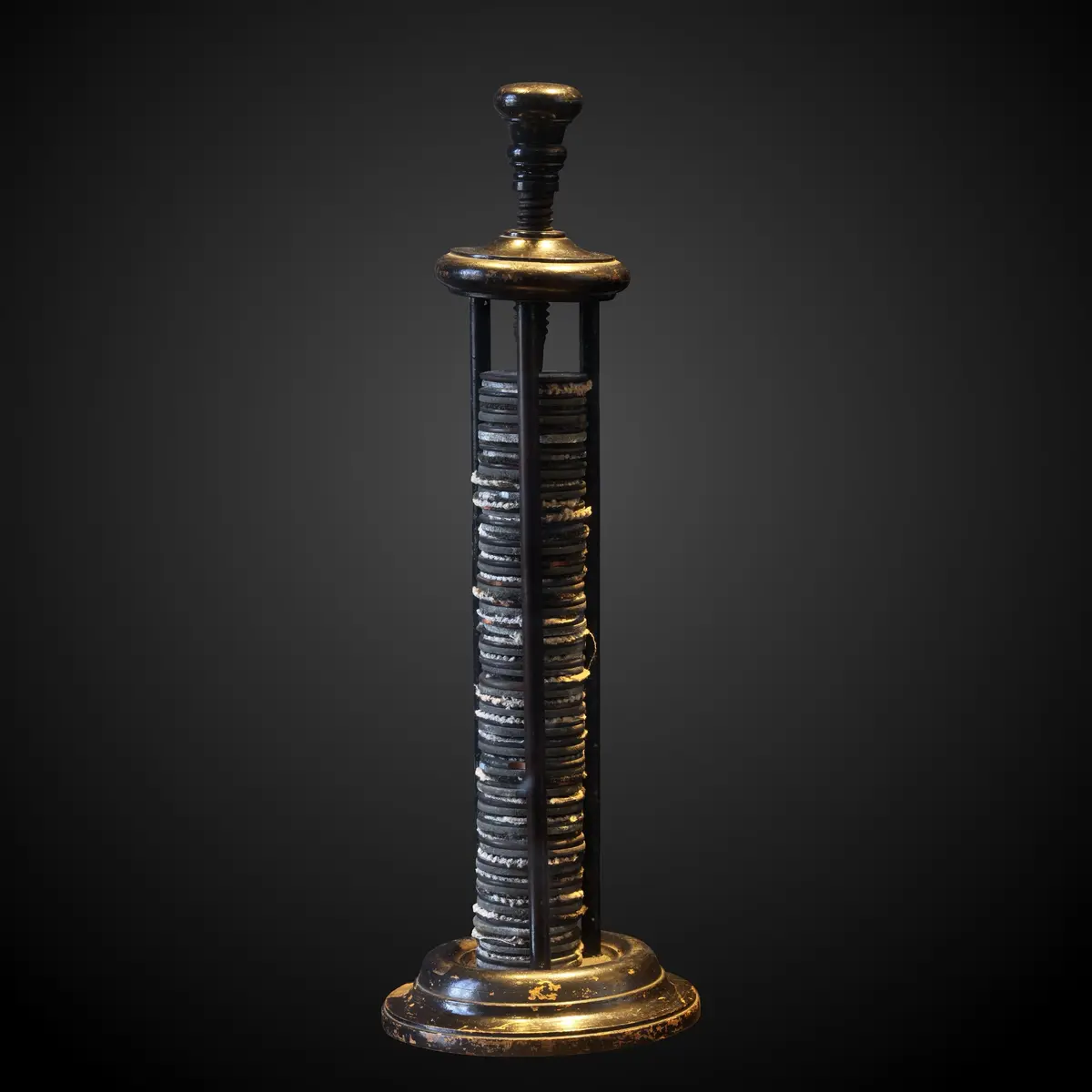
He reports to Collinson on 'what we call'd an Electrical Battery', panes of glass coated with lead and linked together, and, in a letter on thunderstorms to John Mitchell, argues that clouds carry electric charge.
Franklin Court, off Market Street, Philadelphia: the house he had built while in London and lived in after 1785, where he died on 17 April 1790; Philadelphia was his home from 1723- 1750
His 'Opinions and Conjectures' propose pointed iron rods, run down into the ground, to draw lightning silently from clouds and protect buildings, and an experiment to prove that lightning is electricity: a man in a sentry box on a high tower drawing sparks down a rod.
Franklin Court, off Market Street, Philadelphia: the house he had built while in London and lived in after 1785, where he died on 17 April 1790; Philadelphia was his home from 1723- 1751
Collinson has his letters printed in London as Experiments and Observations on Electricity, an 86-page pamphlet; reprinted and translated in French, German and Italian, it makes him famous across Europe.
- 1752
At Marly, near Paris, Thomas-François Dalibard, his French translator, has an assistant carry out Franklin's proposed experiment with a tall iron rod and draw sparks from a thundercloud: lightning is electrical. Delor repeats it in Paris eight days later.
By Joseph Priestley's account of 1767, Franklin, not yet knowing of Marly, flies a silk kite with a pointed wire into a thunderstorm, with his son William, and draws sparks from a key tied to the wet string. He never described the day himself, and some writers doubt the flight took place.
Franklin Court, off Market Street, Philadelphia: the house he had built while in London and lived in after 1785, where he died on 17 April 1790; Philadelphia was his home from 1723He puts a lightning rod on his own house, wired to bells that ring when a passing storm cloud charges it.
Franklin Court, off Market Street, Philadelphia: the house he had built while in London and lived in after 1785, where he died on 17 April 1790; Philadelphia was his home from 1723His Gazette prints his short account of the kite experiment, with directions for repeating it, and announces Poor Richard for 1753, which tells readers how to protect their houses with lightning rods.
Franklin Court, off Market Street, Philadelphia: the house he had built while in London and lived in after 1785, where he died on 17 April 1790; Philadelphia was his home from 1723- 1753
The Royal Society in London awards him its Copley Medal for his 'curious experiments and observations on electricity'. The same year he becomes deputy postmaster general for the northern colonies.
- 1754
As war with France looms, his Gazette prints 'Join, or Die', a snake cut into pieces labelled with the colonies' initials, the first known American cartoon.
Franklin Court, off Market Street, Philadelphia: the house he had built while in London and lived in after 1785, where he died on 17 April 1790; Philadelphia was his home from 1723At the Albany Congress he presents his final draft of a Plan of Union, a general council of all the colonies for their common defence. The colonial assemblies and London both reject it.
- 1757
The Pennsylvania Assembly sends him to London as its agent in its quarrel with the Penn family, the colony's proprietors. He lodges at 36 Craven Street and, apart from 1762–64, stays eighteen years; at sea he writes Father Abraham's speech for the last Poor Richard, later known as The Way to Wealth.
36 Craven Street, London: his lodgings with the widow Margaret Stevenson for most of the years 1757 to 1775 - 1761
In London he completes the glass armonica, nested glass bowls turned on a rod and played with wet fingers; Mozart and Beethoven will write for it.
36 Craven Street, London: his lodgings with the widow Margaret Stevenson for most of the years 1757 to 1775 - 1762
Already 'Dr. Franklin' after an honorary degree from St Andrews in 1759, he receives another from Oxford, sees his son William made royal governor of New Jersey, and sails home to Philadelphia.
Franklin Court, off Market Street, Philadelphia: the house he had built while in London and lived in after 1785, where he died on 17 April 1790; Philadelphia was his home from 1723 - 1764
After losing his seat in the Pennsylvania Assembly he returns to London; Deborah stays behind, and he never sees her again.
36 Craven Street, London: his lodgings with the widow Margaret Stevenson for most of the years 1757 to 1775 - 1766
Before the House of Commons he is questioned for hours on the Stamp Act, which he now opposes; Parliament repeals it, and his testimony restores his name in America.
- 1769
Asked why the mail packets from Falmouth take two weeks longer to reach New York than merchant ships from London take to reach Rhode Island, he learns from his Nantucket cousin Timothy Folger about the Gulf Stream, has him mark it, and has it engraved on a chart of the Atlantic for the Post Office; the packet captains ignore it.
36 Craven Street, London: his lodgings with the widow Margaret Stevenson for most of the years 1757 to 1775 - 1771
Frustrated in his hopes of office, he begins his Autobiography in England, writing to his son about his rise from poverty.
- 1774
For sending Thomas Hutchinson's private letters back to Boston, he stands silent for an hour while the solicitor-general, Alexander Wedderburn, abuses him before the Privy Council; two days later he is dismissed as deputy postmaster.
- 1775
Back in Philadelphia after sailing from England in March, he is at once made a delegate to the Second Continental Congress; in July he lays before it a plan for a confederation of the colonies.
Franklin Court, off Market Street, Philadelphia: the house he had built while in London and lived in after 1785, where he died on 17 April 1790; Philadelphia was his home from 1723- 1776
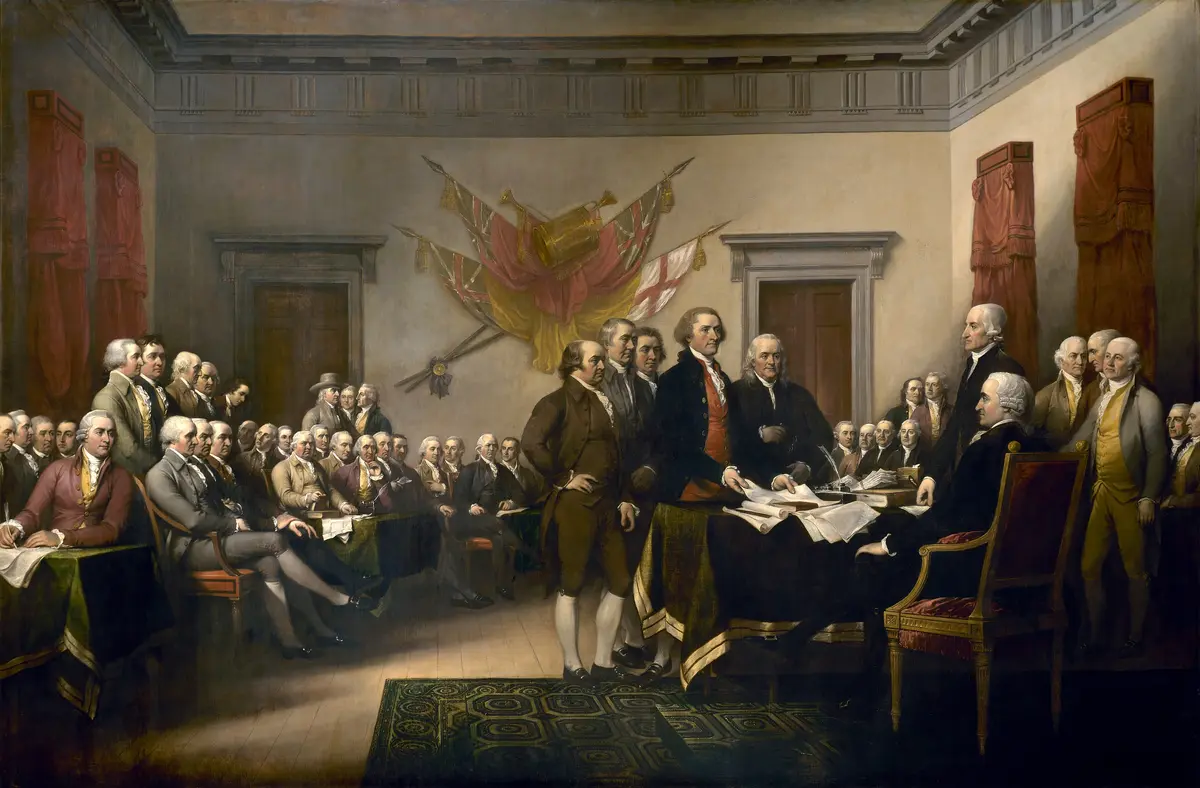
Congress names him to the committee of five, with Jefferson, Adams, Sherman and Livingston, to draft a declaration of independence; he revises Jefferson's draft after Adams, and on 2 August he signs the engrossed copy.
Franklin Court, off Market Street, Philadelphia: the house he had built while in London and lived in after 1785, where he died on 17 April 1790; Philadelphia was his home from 1723Sent by Congress to win French help, he lands at Auray in Brittany with his grandsons and reaches Nantes, still travelling unofficially, before going on to Paris.
- 1777
He settles at Passy, outside Paris, in the Hôtel de Valentinois of his host Jacques-Donatien Le Ray de Chaumont, which becomes the centre of American diplomacy in Europe until 1785.
Hôtel de Valentinois, Passy, then a village outside Paris: his home and the centre of American diplomacy in Europe from 1777 to 1785 - 1778
After the American victory at Saratoga, he, Silas Deane and Arthur Lee sign treaties of commerce and of alliance with France, which recognises the United States and promises no separate peace with Britain.
Louis XVI receives the American commissioners at Versailles; Franklin comes without wig or sword, in a plain brown suit, playing the simple sage the French want to see.
- 1779
He presents his credentials as minister plenipotentiary, the first American envoy received by a foreign government.
He writes to his daughter that medallions, busts and prints 'have made your father's face as well known as that of the moon'.
Hôtel de Valentinois, Passy, then a village outside Paris: his home and the centre of American diplomacy in Europe from 1777 to 1785- 1782
With Adams and Jay he signs provisional articles of peace with Britain in Paris, against Congress's instruction to act with France; he smooths it over with the French foreign minister, Vergennes.
- 1783
Franklin, Adams and Jay sign the Treaty of Paris with Britain's David Hartley: the war is over, and Britain recognises the independence of the United States.
- 1785
Back at work on his Autobiography since 1784, he describes for a London friend, George Whatley, his 'double spectacles', which let him see both his plate and the faces across the table at French dinners: the bifocals he is credited with inventing.
Hôtel de Valentinois, Passy, then a village outside Paris: his home and the centre of American diplomacy in Europe from 1777 to 1785Succeeded in Paris by Thomas Jefferson, he sails home. At sea he writes his 'Maritime Observations', with the Gulf Stream chart; in Philadelphia he is chosen President of Pennsylvania.
Franklin Court, off Market Street, Philadelphia: the house he had built while in London and lived in after 1785, where he died on 17 April 1790; Philadelphia was his home from 1723- 1787
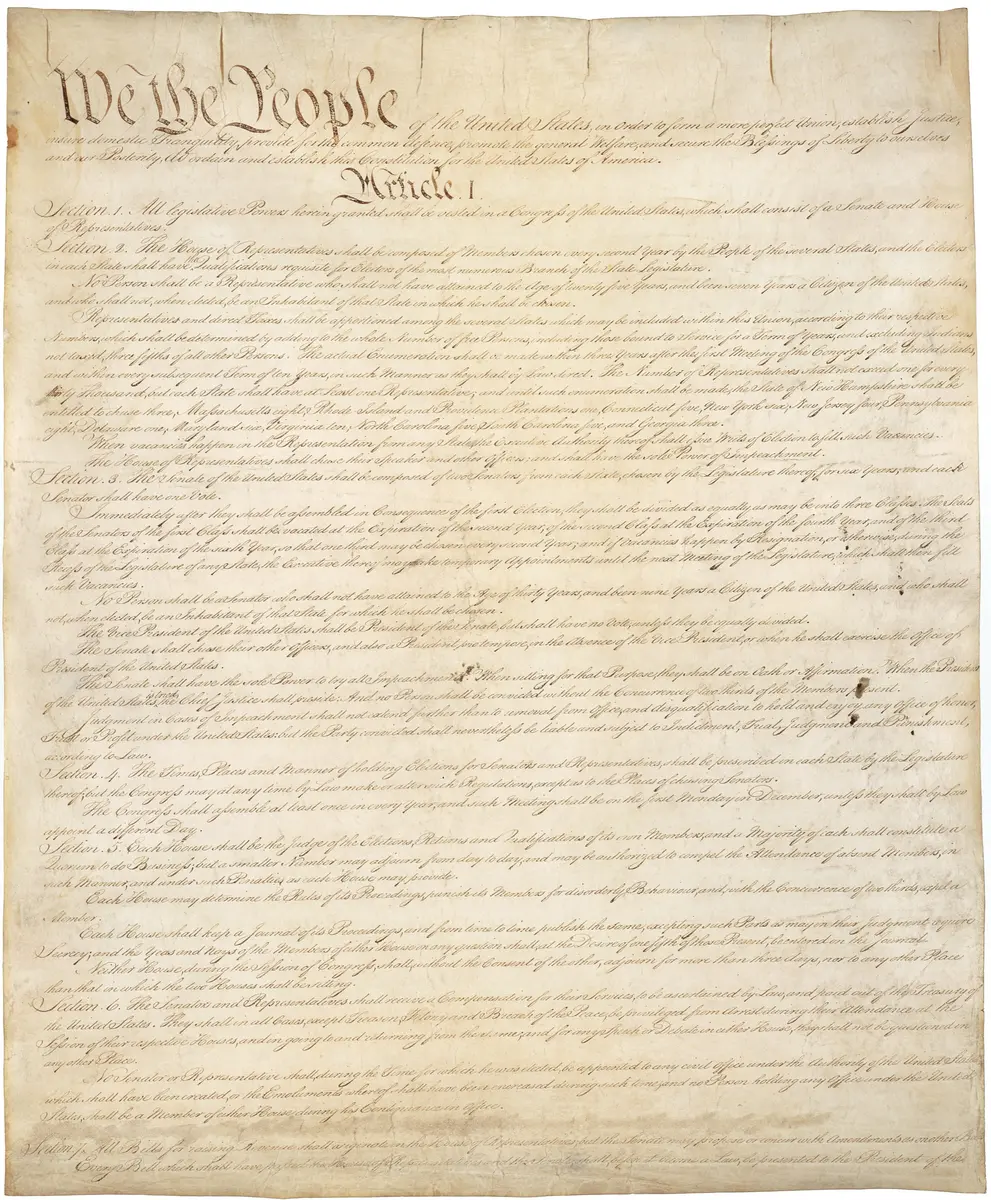
On the last day of the Constitutional Convention, its oldest delegate has James Wilson read his speech: he does not entirely approve of the Constitution, but asks every doubter to 'doubt a little of his own Infallibility' and sign.
Franklin Court, off Market Street, Philadelphia: the house he had built while in London and lived in after 1785, where he died on 17 April 1790; Philadelphia was his home from 1723- 1790
As president of the Pennsylvania Society for Promoting the Abolition of Slavery since 1787, he petitions Congress to end slavery; when congressmen defend it, he mocks them in a newspaper satire printed a month before his death.
Franklin Court, off Market Street, Philadelphia: the house he had built while in London and lived in after 1785, where he died on 17 April 1790; Philadelphia was his home from 1723Franklin dies in his house at Franklin Court, aged 84. He is buried beside Deborah in Christ Church Burial Ground, and his Autobiography is published after his death.
Franklin Court, off Market Street, Philadelphia: the house he had built while in London and lived in after 1785, where he died on 17 April 1790; Philadelphia was his home from 1723