Mozart
“The Salzburg prodigy who settled in Vienna and, before his death at 35 in 1791, wrote The Marriage of Figaro, Don Giovanni, The Magic Flute and the Requiem, mastering every musical form of his day.”
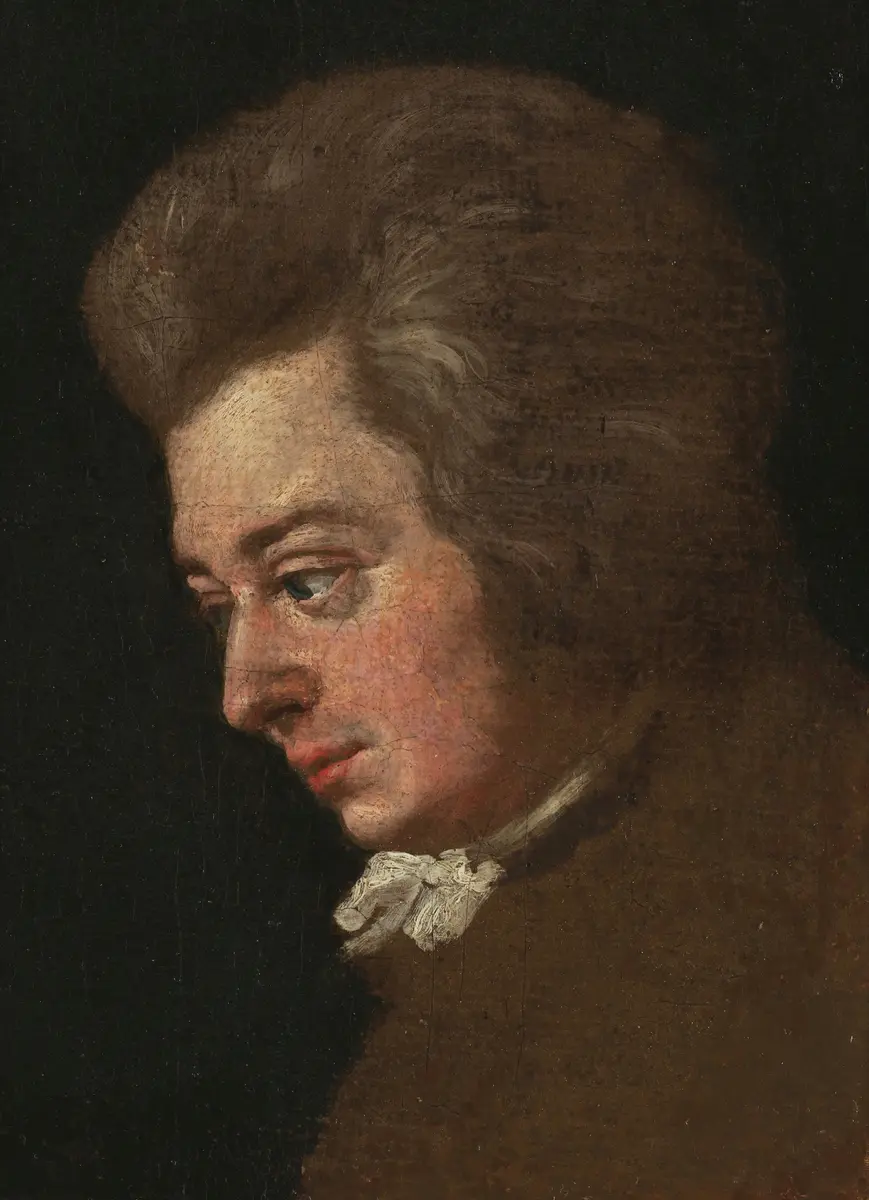
Wolfgang Amadeus Mozart was an Austrian composer, widely counted among the greatest who ever lived. In a life of only 35 years he wrote more than 600 works in every kind of music of his day: symphonies, piano concertos, string quartets, church music and 22 works for the stage. He was outstanding in all of them, which no other composer has managed. He did not invent new forms; he took the ones he found and raised them to a new level, and with Joseph Haydn and Ludwig van Beethoven he brought the Viennese Classical style to its peak. He usually signed himself Wolfgang Amadé.
He was born in Salzburg on 27 January 1756. The city was then the capital of a small church state inside the Holy Roman Empire, ruled by a prince-archbishop. His father Leopold, a violinist at the archbishop's court, published a famous textbook on violin playing that same year; of his seven children only Wolfgang and his elder sister Maria Anna, called Nannerl, survived. The boy picked out chords at three and composed at five, and Leopold, who called him the miracle God had let be born in Salzburg, set out to show him to the world. In 1762 the children played for Empress Maria Theresa in Vienna. From 1763 to 1766 the family toured Germany, Paris, London and the Netherlands, where Wolfgang met Johann Christian Bach and wrote his first symphonies. Between 1769 and 1773 father and son made three journeys to Italy, where the boy wrote operas for Milan, copied out from memory a piece of music the Sistine Chapel kept to itself, and was made a knight by the pope.
Back home he served in the court orchestra of a new archbishop, Hieronymus Colloredo, a reformer who wanted short masses and little show. Mozart felt wasted there. In 1777 he set out with his mother to find a post in Mannheim or Paris; he found none, fell in love with the singer Aloysia Weber, and lost his mother, who died in Paris in July 1778. In 1781, after the success of his opera Idomeneo in Munich, he quarrelled with Colloredo in Vienna and was thrown out of his service. He stayed on in Vienna and lived as a free musician, by teaching, playing, publishing and writing to order: a bold step for a musician of his time, and one his father opposed.
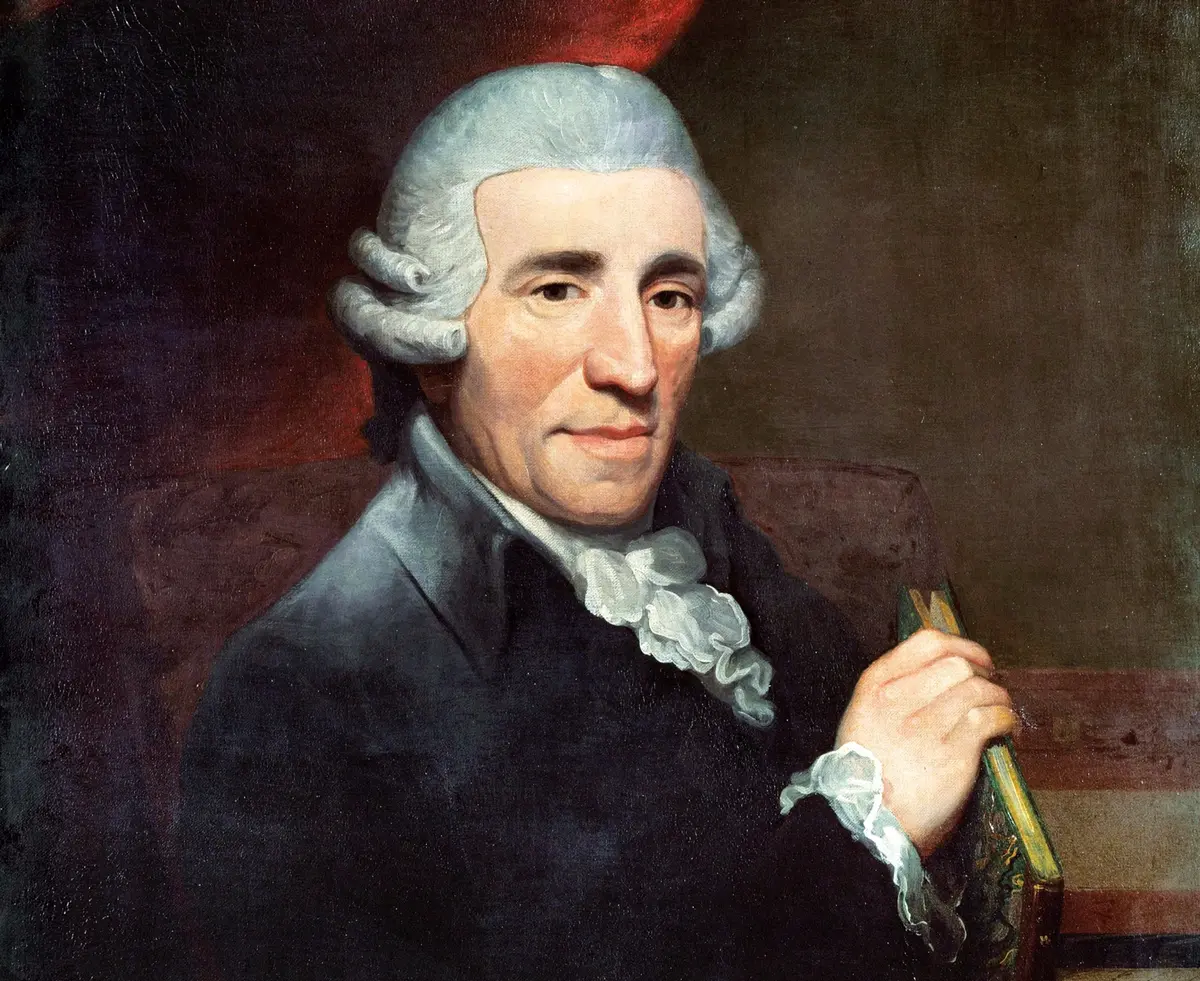
The ten Vienna years were his greatest. His German opera The Abduction from the Seraglio (1782) was a hit across the German-speaking lands, and that same summer he married Aloysia's younger sister Constanze. He gave crowded concerts at which he played his own piano concertos, became a close friend of Haydn, who called him the greatest composer he knew, and joined the Freemasons. With the court poet Lorenzo Da Ponte he wrote three Italian comic operas: The Marriage of Figaro (1786), Don Giovanni (1787, first given in Prague) and Così fan tutte (1790). In 1787 Emperor Joseph II made him his chamber musician. Money was tight in the war years after 1788 and he borrowed from a fellow Mason, but he never went hungry. His last year brought The Magic Flute, La clemenza di Tito, the Clarinet Concerto and a secret commission for a Requiem. He fell ill in November 1791 and died on 5 December, aged 35, of what his death record calls a severe miliary fever. There is no evidence for the old story that Antonio Salieri poisoned him. He was buried in an ordinary grave outside the city, as was usual at the time, and his pupil Franz Xaver Süssmayr finished the Requiem.
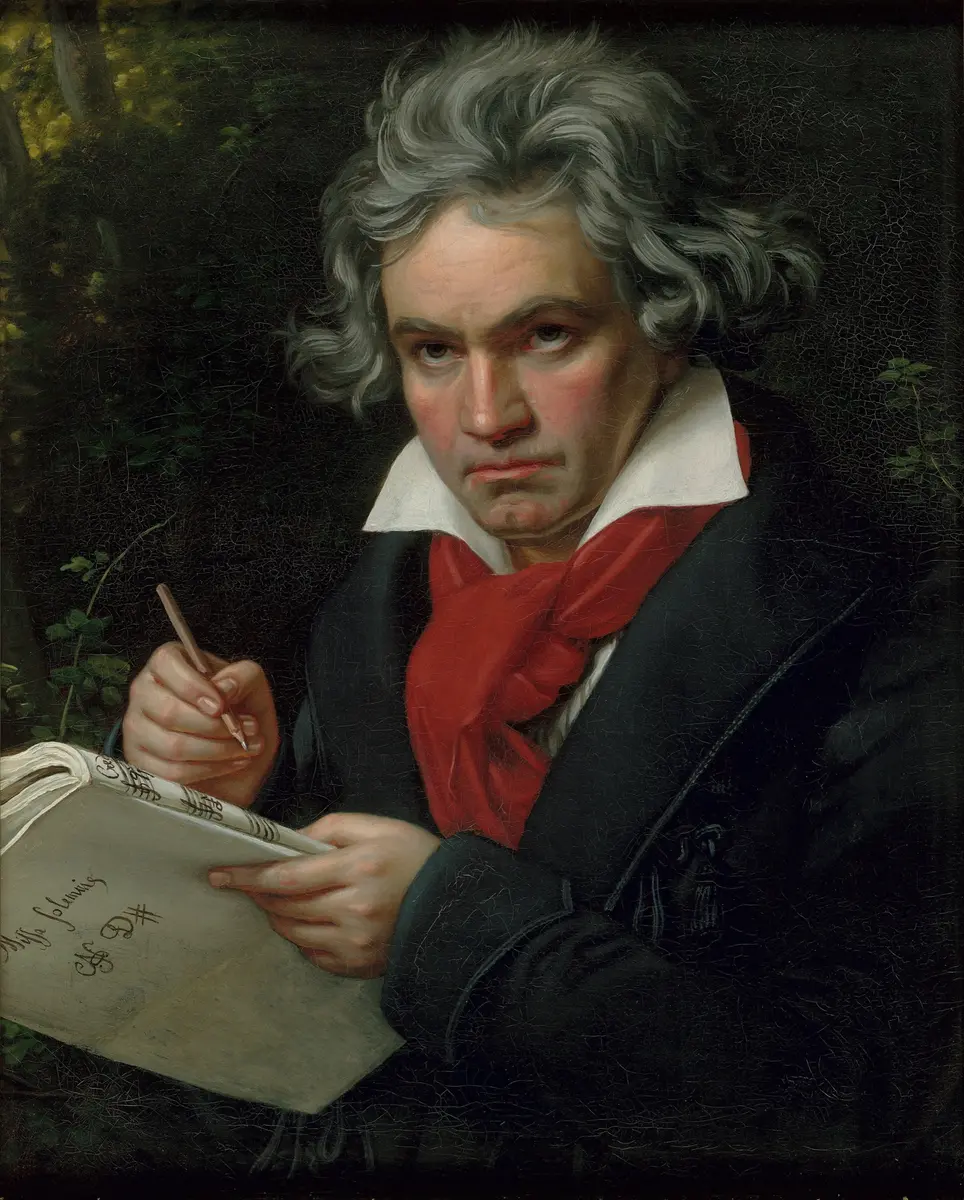
Newspapers across Europe mourned him, which had not happened for any composer before. His widow sold his manuscripts and helped the first biographies into print, and in 1862 Ludwig von Köchel catalogued all his works, which is why each piece carries a 'K' number. The nineteenth century loved his three great operas and his darker works but thought that Beethoven, who had come to Vienna in 1787 hoping to study with him, had gone further; the twentieth century came to hear in him an artist of perhaps unequalled range. Peter Shaffer's play Amadeus and Miloš Forman's film of 1984 made him famous to millions, but also spread the myths of the childish genius and of Salieri's poison. His world was the Vienna of Maria Theresa and Joseph II, of the Enlightenment and the Masonic lodges, and his music is still heard everywhere, from concert halls to airports.
What happened
- 1756
Born in Salzburg, in the family's flat on the third floor of the Hagenauer house in the Getreidegasse, the seventh and last child of Leopold and Anna Maria Mozart; he is baptised Joannes Chrysostomus Wolfgangus Theophilus.
Getreidegasse 9, Salzburg: the Hagenauer house, where he was born on the third floor and grew up- 1762
At Schönbrunn palace in Vienna the six-year-old plays for Empress Maria Theresa and Emperor Francis I, jumps into the empress's lap and kisses her, as his father proudly writes home; she gives the children court clothes.
- 1763
On a tour that began in June, the family reaches Paris. The children play for Louis XV at New Year, Wolfgang's first sonatas are printed, and Carmontelle draws father, son and daughter making music.
- 1764
The family arrives in London for some fifteen months. They play for George III, Wolfgang meets Johann Christian Bach, the youngest son of Johann Sebastian, and under his influence writes his first symphonies.
- 1766
After more than three years on the road, through the Netherlands, Paris and Switzerland, the Mozarts are home in Salzburg, 'to the solace and joy of the whole town', as a monk of St Peter's notes in his diary.
Getreidegasse 9, Salzburg: the Hagenauer house, where he was born on the third floor and grew up- 1769
Father and son leave for Italy, where mastery of Italian opera was the key to an international career; mother and sister stay at home.
- 1770
In Rome for Holy Week he hears Allegri's Miserere in the Sistine Chapel, music the papal choir kept to itself, and writes it out from memory.
Pope Clement XIV makes him a Knight of the Order of the Golden Spur; that summer near Bologna, with help from Padre Martini, he passes the examination for the city's Accademia Filarmonica.
His opera Mitridate, re di Ponto opens the carnival season at the Regio Ducal Teatro in Milan and runs for 22 performances; he is 14.
- 1772
The new prince-archbishop, Hieronymus Colloredo, elected in March, makes him a paid concertmaster of the Salzburg court music.
Lucio Silla, his third opera for Milan, has its premiere; it starts three hours late and lasts six, and then runs for 26 performances. In March 1773 he is home for good from Italy.
- 1775
His comic opera La finta giardiniera is given at the Munich carnival; back in Salzburg that year he writes most of his five violin concertos, growing more sure of the form from one to the next.
- 1777
Having asked the archbishop to release him, he sets out with his mother to look for a post: Munich, Augsburg, then Mannheim, where he falls in love with the singer Aloysia Weber.
- 1778
In Paris, which they reached in March, his new symphony in D (K 297), written to the Parisians' taste for brilliant orchestral effects, is played at the Concert Spirituel.
His mother dies in Paris after a short illness. He breaks the news to his father gently, through a friend in Salzburg, and moves in with Baron Grimm.
- 1779
Back in Salzburg, unwillingly, as court and cathedral organist on better terms; there he writes the Coronation Mass.
- 1781
Idomeneo, his serious opera for the Elector's court, has its premiere at the Cuvilliés-Theater in Munich, two days after his 25th birthday; he conducts from the harpsichord.
Summoned to Vienna with the archbishop's household, seated below the valets and kept from giving concerts, he asks to leave. The archbishop's steward, Count Arco, throws him out, by Mozart's account with a kick. He stays in Vienna as a free musician, lodging with the Webers.
- 1782
The Abduction from the Seraglio, a German opera for Joseph II's court theatre, opens at the Burgtheater and soon plays all over the German-speaking lands.
He marries Constanze Weber, Aloysia's younger sister, in St Stephen's Cathedral; his father's grudging consent arrives the next day.
- 1783
On their only visit together to Salzburg after the wedding, the movements he has finished of his Mass in C minor are sung at St Peter's, with Constanze in the soprano part; on the way home, at Linz, he hastily writes a symphony for a concert there.
- 1784
He begins to keep a catalogue of his own works, a sign, Britannica suggests, of a new awareness of posterity and of his place in it.
His son Carl Thomas, the elder of the two children who survive, is born on 21 September; the family moves into the large flat in the Domgasse behind St Stephen's, its home until 1787.
Domgasse 5, Vienna: the flat behind St Stephen's where he lived from 1784 to 1787 and wrote The Marriage of FigaroHe becomes a Freemason. The lodges, with their ideals of reason and brotherhood, mean much to him from now on; he writes music for them and, at the end, The Magic Flute.
- 1785
His father, visiting, hears three of the six quartets Wolfgang is dedicating to Haydn, and Haydn tells him: 'Your son is the greatest composer known to me in person or by name.'
At the height of his concert career he plays new piano concertos to full halls; Leopold writes that his son's fortepiano has been carried to the theatre or some other house at least a dozen times since he arrived.
- 1786
The Marriage of Figaro, written with Lorenzo Da Ponte after Beaumarchais's banned comedy, opens at the Burgtheater; so many numbers are encored that the emperor limits encores.
- 1787
In Prague, where Figaro is the talk of the town, he conducts it himself, gives a concert with his new 'Prague' symphony, and is asked for a new opera for the autumn.
The Estates Theatre, Prague: then Count Nostitz's theatre, where Don Giovanni had its first performance in 1787His father dies in Salzburg. In April, hearing he was gravely ill, Wolfgang had written to him that death, 'the true friend of man', held no terror for him.
Don Giovanni has its first performance at Count Nostitz's theatre in Prague and is warmly received; he is said to have written the overture only days before.
The Estates Theatre, Prague: then Count Nostitz's theatre, where Don Giovanni had its first performance in 1787Joseph II makes him his chamber musician, in place of the late Gluck, at 800 gulden a year; his main duty is to write dances for the court balls.
- 1788
In a hard year, with the Turkish war emptying Viennese purses and begging letters to his fellow Mason Michael Puchberg, he writes his last three symphonies, in E flat, G minor and C major, the 'Jupiter', between June and August.
- 1789
With Prince Lichnowsky he travels to Berlin by way of Prague, Dresden and Leipzig, where he plays the organ of Bach's Thomaskirche; he plays at the Prussian court but comes home with little money.
- 1790
Così fan tutte, the third Da Ponte opera, opens at the Burgtheater; its run stops after five performances when Joseph II dies in February.
In Frankfurt, where the new emperor, Leopold II, has been crowned, he gives a concert of his own: a musical success and a financial failure.
- 1791
He is made unpaid assistant to the ageing Kapellmeister of St Stephen's Cathedral, with the promise of the post itself; the old man outlives him.
His son Franz Xaver is born on 26 July. About the same time a messenger brings an anonymous commission for a Requiem; it comes from Count Walsegg, who means to pass it off as his own in memory of his wife.
In Prague for Leopold II's coronation as king of Bohemia, he conducts the premiere of La clemenza di Tito, an opera written in a few weeks with Süssmayr's help.
The Magic Flute, a German fairy-tale opera with Masonic ideas, written with the actor-manager Emanuel Schikaneder for his suburban Theater auf der Wieden, has its first night; it soon plays to full houses.
He conducts a short Masonic cantata at his lodge; about 20 November he falls seriously ill and takes to his bed.
- 12:55 a.m.
He dies at home in the Rauhensteingasse, aged 35, the Requiem unfinished. The certified cause is 'severe miliary fever'. On 6 December his body is blessed at St Stephen's, and he is buried at St Marx cemetery outside the walls in an ordinary grave, as the custom was.
Rauhensteingasse 8, Vienna: the site of the house where he died on 5 December 1791, pulled down in 1849