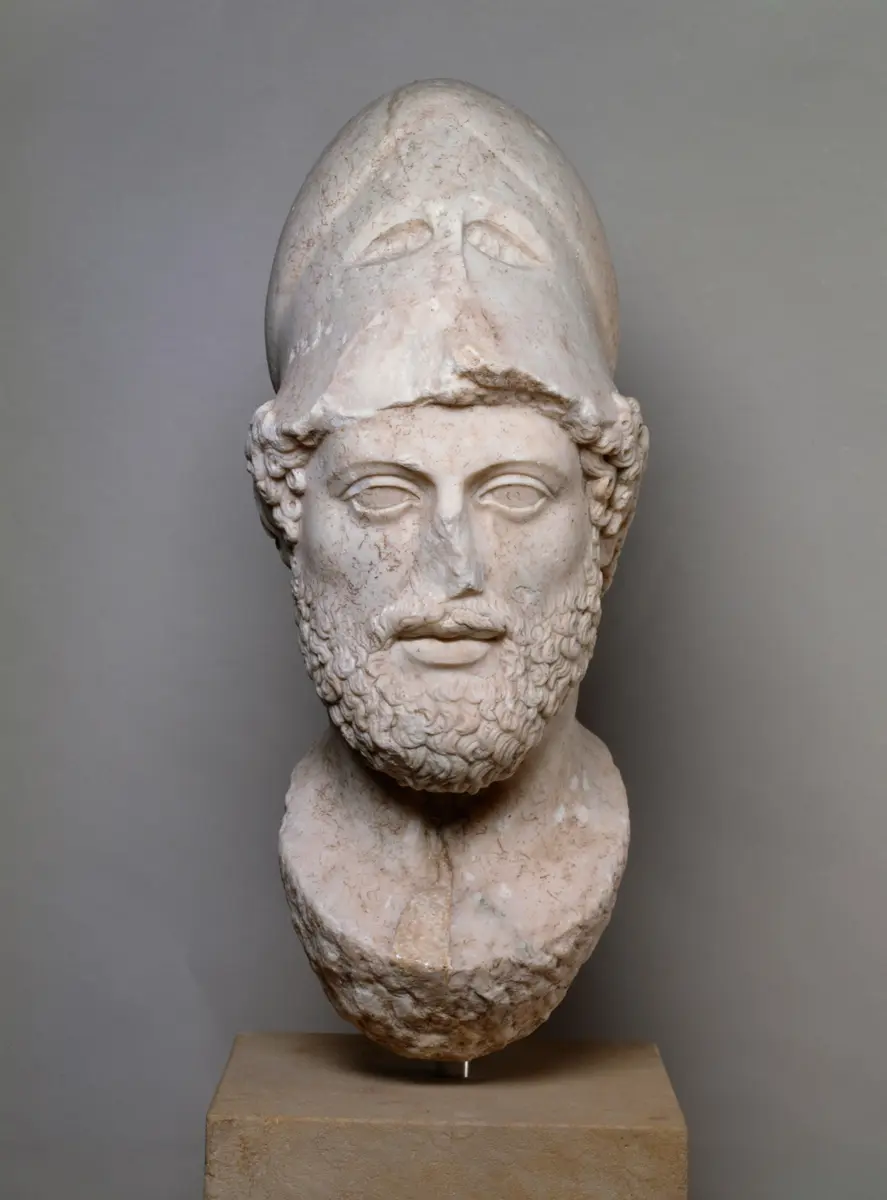
Pericles
“The general who led democratic Athens at its height for some thirty years, built the Parthenon, gave the Funeral Oration and died of the plague in 429 BCE.”
Pericles, son of Xanthippus, was the leading statesman of Athens for about thirty years in the middle of the fifth century BCE, the city's golden age. He was born about 495 BCE into its highest nobility: his father commanded the Greeks at Mycale in 479, and his mother Agariste belonged to the Alcmaeonid family of Cleisthenes, the founder of the democracy. Yet he made his career as the leader of the people. He never held an office higher than general (strategos), one of ten elected every year, but he was elected almost every year, and from 443 for fifteen years without a break. Thucydides, who heard him speak, wrote that what was in name a democracy became in his hands government by the first citizen.
He rose with Ephialtes, who in 462/1 took the political powers of the old council of the Areopagus away from the nobles; in the same year the Athenians ostracized his conservative rival Cimon. Pericles then made democracy something a poor man could afford, with pay for jurors, and in 451/0 his law limited citizenship to children of an Athenian father and an Athenian mother. He turned the Delian League, the alliance against Persia, into an Athenian empire: its treasury was moved from Delos to Athens in 454, and from 447 the city's money, part of it perhaps the allies' tribute, paid for his building programme on the Acropolis, the Parthenon with Phidias's gold-and-ivory Athena, the Propylaea and, below them, the Odeon. His opponents called it waste; in 443 the Assembly ostracized their leader, Thucydides son of Melesias, instead of him.
He was a cautious general who made peace with Sparta in 446/5 and crushed rebellious allies, Euboea in 446 and Samos in 440 to 439. In 432 he persuaded the Assembly to refuse Sparta's demands over Megara and Potidaea, and in 431 the Peloponnesian War began. His plan was to bring the people of Attica inside the walls, let the Spartans burn the fields, refuse battle on land and raid the enemy's coasts by sea, trusting the Long Walls to Piraeus, the fleet and the empire's money to outlast them. In the winter of 431/0 he spoke at the public funeral of the war's first dead; Thucydides's version of the speech, the Funeral Oration, calls Athens 'the school of Hellas'. In 430 plague broke out in the crowded city. The Athenians deposed and fined him, then elected him again, and he died of the plague in the autumn of 429, two and a half years into the war.
His circle was the intellectual world of Athens: the philosopher Anaxagoras, the sculptor Phidias, the music teacher Damon, the playwright Sophocles. From the 440s his companion was Aspasia of Miletus, a foreign woman the comic poets mocked as a courtesan; after his two sons by his wife died of the plague, the Assembly made their son, another Pericles, a citizen. In the late 430s his enemies struck at him through his friends, with charges against Phidias, Anaxagoras and Aspasia. Thucydides judged that Athens lost the war by abandoning his advice; modern historians argue over whether his strategy could ever have won it. The temples he began on the Acropolis are the most famous buildings in Greece, and his funeral speech, echoed by Lincoln at Gettysburg, still shapes how democracies honour their war dead.
What happened
- 495 BCE
Born in Athens, of the deme Cholargos, to Xanthippus and Agariste, an Alcmaeonid of the family of Cleisthenes, the founder of the democracy.
- 484 BCE
His father Xanthippus is ostracized, the first man banished who had no tie to the old tyrants; recalled with the other exiles before Xerxes's invasion, he commands the Greeks at Mycale in 479.
- 463 BCE
After the revolt of Thasos the young Pericles, Ephialtes's lieutenant, prosecutes Cimon, the hero of the Delian League, at the scrutiny of his command; Cimon is acquitted.
- 461 BCE
In 462/1 Ephialtes strips the council of the Areopagus of its political powers, and the Athenians ostracize Cimon; after Ephialtes is murdered, Pericles leads the democrats. He introduces pay for jurors so that poor citizens can serve.
- 457 BCE
The Long Walls joining Athens to its harbour at Piraeus are finished, making city and port one fortress; later Pericles himself proposes a third, middle wall.
Piraeus: Athens's war harbour, joined to the city by the Long Walls; the plague of 430 BCE broke out here first - 454 BCE
After an Athenian fleet is lost in Egypt, the Delian League's treasury is moved from Delos to the Acropolis; from 454/3 a sixtieth of every ally's tribute goes to Athena and is listed on stone. Pericles leads a fleet into the Corinthian Gulf.
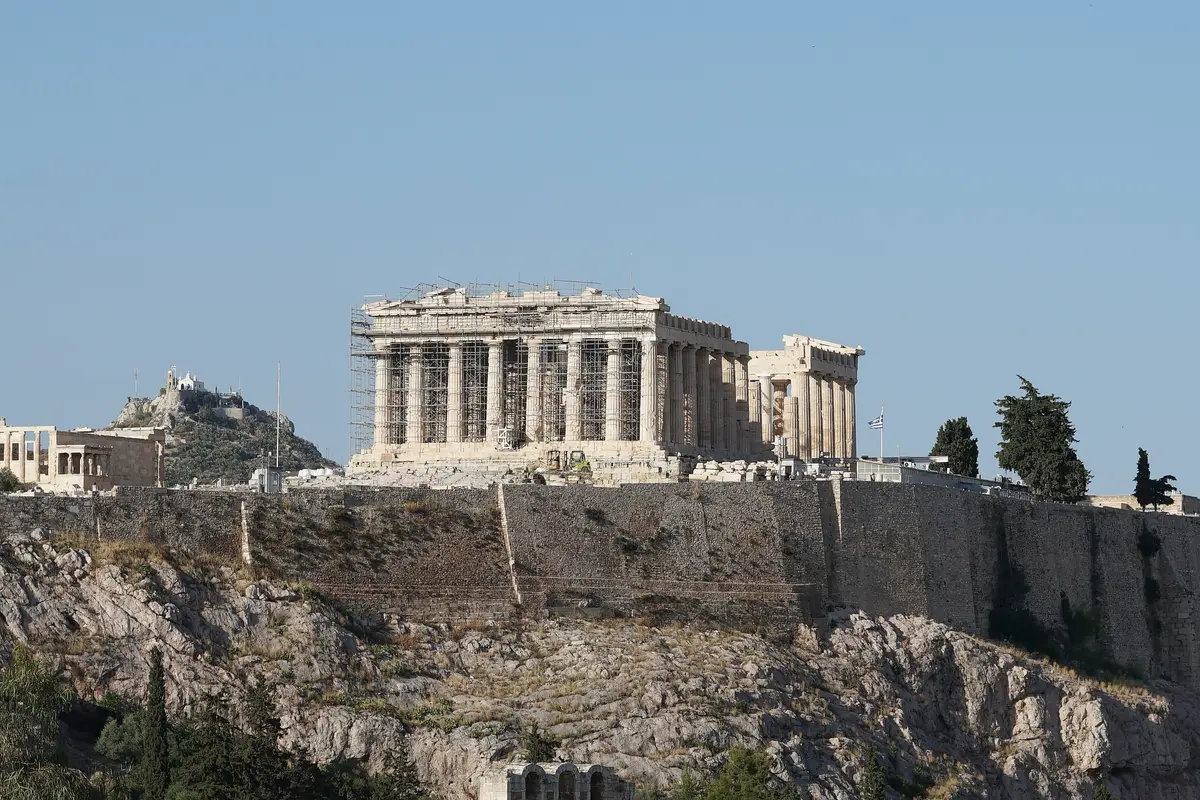
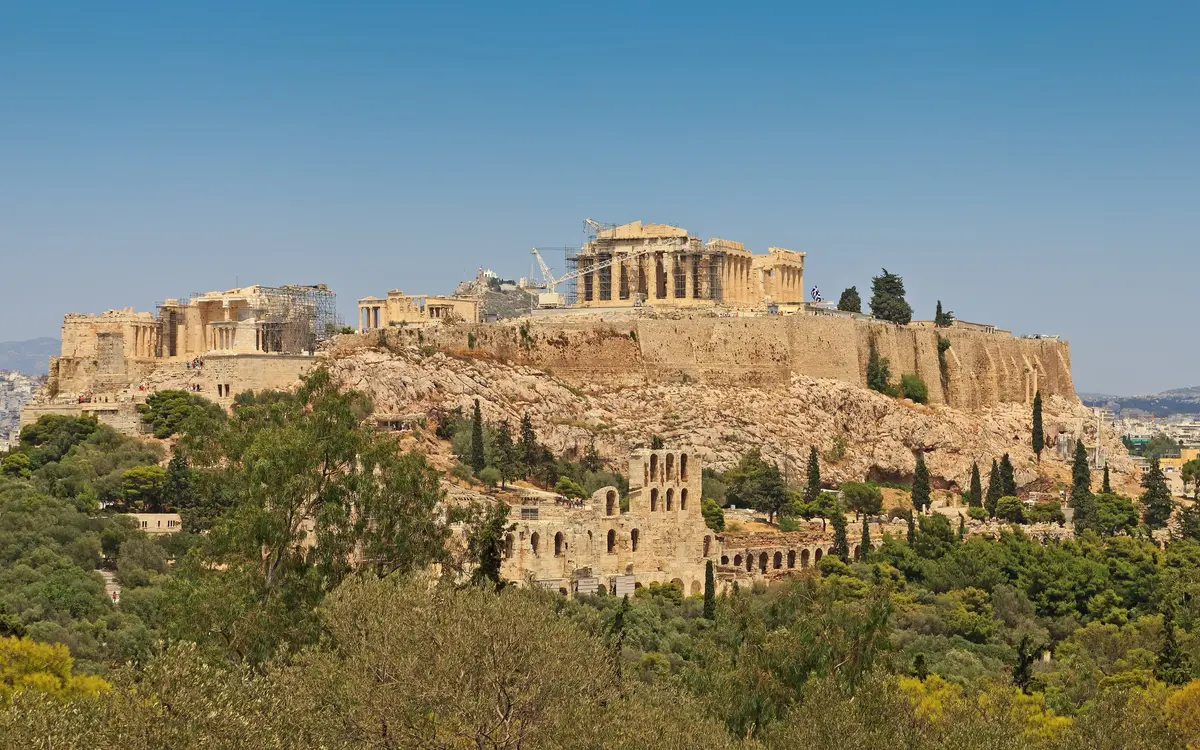
The Acropolis: the Parthenon, the Propylaea and Phidias's gold-and-ivory Athena of his building programme, from 447 BCE, and the stones of the tribute lists - 451 BCE
His law, passed in the year 451/0, makes citizens only of children whose father and mother are both Athenian.
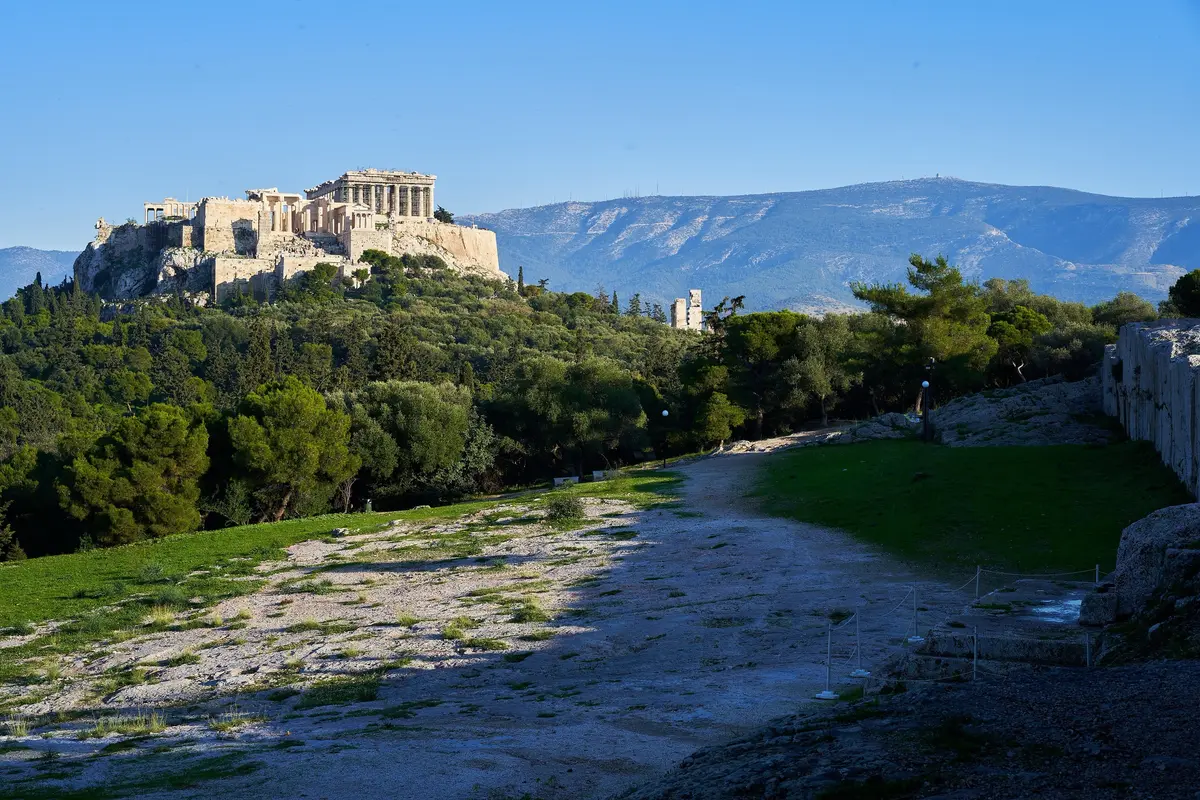
The Pnyx: the hill where the Assembly met, elected him general year after year, refused Sparta's demands in 432 and fined him in 430 - 447 BCE
The building programme on the Acropolis begins with the Parthenon, designed by Iktinos and Kallikrates, with Phidias in charge of the sculpture.
The Acropolis: the Parthenon, the Propylaea and Phidias's gold-and-ivory Athena of his building programme, from 447 BCE, and the stones of the tribute lists - 446 BCE
Euboea and Megara revolt and a Spartan army invades Attica; Pericles persuades the Spartans to withdraw without a battle, then reconquers Euboea. A peace for thirty years with Sparta follows in the winter of 446/5.
- 445 BCE
In these years Aspasia of Miletus, a foreign woman settled in Athens, becomes his companion; Pericles parts with his wife, the mother of his sons Xanthippus and Paralus, and has a son by Aspasia, also called Pericles.
- 443 BCE
His opponents, led by Thucydides son of Melesias, attack the cost of the buildings; the Assembly ostracizes Thucydides instead of Pericles, who is now elected general fifteen years running.
About this time the Odeon rises below the Acropolis under his supervision; the comic poet Cratinus mocks him as 'squill-head Zeus', the Odeon like a cap on his head, 'now that the ostracism is over'.
The Odeon of Pericles: the great roofed music hall built under his supervision on the south-east slope of the Acropolis- 440 BCE
Samos revolts; Pericles takes command, blockades the island and forces its surrender after eight months, in 439, and speaks at the funeral of the Athenians who fell.
- 438 BCE
Phidias's gold-and-ivory statue of Athena Parthenos, twelve metres high, is set up in the new temple.
The Acropolis: the Parthenon, the Propylaea and Phidias's gold-and-ivory Athena of his building programme, from 447 BCE, and the stones of the tribute lists - 437 BCE
Work begins on the Propylaea, the gateway of the Acropolis, by the architect Mnesikles; the same year Pericles sails into the Black Sea with a fleet to show Athens's power.
The Acropolis: the Parthenon, the Propylaea and Phidias's gold-and-ivory Athena of his building programme, from 447 BCE, and the stones of the tribute lists - 432 BCE
The Parthenon is finished. In these years his enemies prosecute his friends: Phidias over the gold of the statue, the philosopher Anaxagoras for impiety, Aspasia too.
The Acropolis: the Parthenon, the Propylaea and Phidias's gold-and-ivory Athena of his building programme, from 447 BCE, and the stones of the tribute listsSparta threatens war unless Athens lifts its trade ban on Megara and its siege of Potidaea; Pericles persuades the Assembly to refuse every concession.
The Pnyx: the hill where the Assembly met, elected him general year after year, refused Sparta's demands in 432 and fined him in 430- 431 BCE
The Peloponnesian War begins. As the Spartans invade Attica, the country people move inside the walls on Pericles's advice and watch their farms burn, while the fleet raids the Peloponnese.
In the winter Pericles is chosen to speak at the public funeral of the war's first dead in the cemetery by the Dipylon gate: the Funeral Oration, in which, as Thucydides gives it, he calls Athens the school of Hellas.
The Kerameikos: the public cemetery by the Dipylon gate, where he gave the Funeral Oration in the winter of 431/0 BCE and was buried in 429- 430 BCE
Plague breaks out, first in Piraeus, then in the crowded city; it will kill perhaps a third of the people. Pericles leads a fleet against Epidaurus.
Piraeus: Athens's war harbour, joined to the city by the Long Walls; the plague of 430 BCE broke out here firstThe angry Athenians send envoys to Sparta, depose Pericles and fine him, by Plutarch's figures between 15 and 50 talents.
The Pnyx: the hill where the Assembly met, elected him general year after year, refused Sparta's demands in 432 and fined him in 430- 429 BCE
Re-elected general. His legitimate sons Xanthippus and Paralus have died of the plague, and the Assembly suspends his own citizenship law so that his son by Aspasia can be enrolled as an Athenian.
He dies of the plague in the autumn, two years and six months after the war began, and is buried near the Dipylon gate.
The Kerameikos: the public cemetery by the Dipylon gate, where he gave the Funeral Oration in the winter of 431/0 BCE and was buried in 429