Raphael
“With Leonardo and Michelangelo the third giant of the High Renaissance: the painter of serene Madonnas and of the School of Athens in the Vatican, who died at 37.”
Raphael (Raffaello Santi, or Sanzio) was the painter and architect who, with Leonardo da Vinci and Michelangelo, made up the great trio of the High Renaissance. He died at 37, yet in twenty years of work he left a great body of altarpieces, Madonnas, portraits and frescoes, and in his last years he ran nearly all of the papacy's artistic projects in Rome. His pictures are admired for their clarity, calm and ease: figures that move naturally in a space that feels ordered and complete. His School of Athens, a gathering of the philosophers of antiquity painted on a wall of the pope's private apartment in the Vatican, is perhaps his most famous painting and one of the landmarks of the Renaissance.
He was born in Urbino in 1483, the son of Giovanni Santi, court painter to the dukes of Urbino, whose court under Federico da Montefeltro had become one of the most cultivated in Italy. His mother died when he was eight and his father when he was eleven. He trained, as a pupil or an assistant, in the workshop of Pietro Perugino, the leading painter of central Italy, and in December 1500, aged seventeen, he was already called a 'master' in a document commissioning an altarpiece. His Marriage of the Virgin of 1504, which takes Perugino's design and outdoes it, was his first masterpiece. That autumn he moved to Florence, where Leonardo and Michelangelo were at work, and learned from both: Leonardo's soft shading and pyramid-shaped groups in a series of gentle Madonnas, Michelangelo's powerful bodies in the Deposition of 1507.
Late in 1508 Pope Julius II called him to Rome, on the advice of the architect Bramante, who also came from the duchy of Urbino, and Raphael stayed there for the rest of his life. His first task was to paint the rooms of the pope's apartment, the Stanze. In the first, the Stanza della Segnatura, theology and philosophy face each other: the Disputa, with the saints in heaven above an altar, and the School of Athens, with Plato and Aristotle at its centre, Michelangelo as the brooding Heraclitus and Raphael himself at the right edge. In the next room, miracles from the church's past, among them the Mass at Bolsena with Julius kneeling and the Liberation of St Peter lit by an angel in the dark, carried the warrior pope's politics. In the same years he painted the sea nymph Galatea for the banker Agostino Chigi, the Sistine Madonna, and the portraits that made him the leading portraitist in Rome. Handsome and charming as well as gifted, he was called 'the prince of painters'.
Under Leo X, the Medici pope elected in 1513, his role grew still larger. When Bramante died in 1514 he took over the building of the new St Peter's; the pope put him in charge of ancient marbles with inscriptions in 1515 and made him commissioner of the city's antiquities two years later, and with his friend the writer Baldassare Castiglione he drew up a memorandum on saving the ruins of ancient Rome. For the Sistine Chapel he designed ten great tapestries of the lives of Saints Peter and Paul, woven in Brussels; seven were hung there for the first time on 26 December 1519. A large workshop, Giulio Romano among them, carried out much of the later work. His last altarpiece, the Transfiguration, was still not quite finished when he died of a fever on 6 April 1520, Good Friday and, by the usual account, his 37th birthday. It was set up at the head of his bier, and he was buried, as he had wished, in the Pantheon.
For centuries he was held to be the supreme painter of the High Renaissance, in the words of London's National Gallery more versatile than Michelangelo and more prolific than Leonardo. His balanced, classical style was the model of the European academies until the middle of the nineteenth century; his tapestry cartoons, bought by the future Charles I of England in 1623, set the pattern for European history painting for centuries, and the crowded drama of the Transfiguration already points towards Mannerism and the Baroque. When three young students of the Royal Academy in London founded the Pre-Raphaelite Brotherhood in 1848, they named themselves after the art that came before him, in revolt against the academic painting that had made him its ideal.
What happened
- 1483
Born in Urbino, the son of Giovanni Santi, painter at the court of the dukes of Urbino, and Magia di Battista Ciarla.
Casa Santi, Urbino: the house where he was born in 1483, now the museum of his birthplace- 1491
His mother dies; he is eight.
- 1494
His father dies, after giving the eleven-year-old his first lessons in painting and an introduction to the humanist culture of the court.
- 1500
Already called a 'master' at seventeen, he is commissioned to help paint an altarpiece, due by 13 September 1502: the altarpiece of Saint Nicholas of Tolentino for Sant'Agostino in Città di Castello. He works in Perugino's circle in Perugia, where his master has just painted the Collegio del Cambio, perhaps with Raphael as an assistant.
The chapel of San Severo, Perugia: the fresco he began about 1505, in the city where he trained in Perugino's circle- 1503
The banker Domenico Gavari's altarpiece of the Crucifixion is set up in San Domenico at Città di Castello in a stone frame dated 1503; in Perugia he paints the Coronation of the Virgin for the Oddi chapel, the work of his closest to Perugino.
- 1504
He signs and dates the Marriage of the Virgin for San Francesco in Città di Castello, built on Perugino's design but freer: his first masterpiece.
By the autumn he is in Florence, drawn by the work of Leonardo and Michelangelo; he studies them, Fra Bartolommeo and the older frescoes of Masaccio.
Florence, where he lived and worked from 1504 to 1508- 1505
Still working for Perugian patrons, he paints the Ansidei altarpiece for San Fiorenzo and begins the fresco of the chapel of San Severo, which he will leave unfinished.
The chapel of San Severo, Perugia: the fresco he began about 1505, in the city where he trained in Perugino's circleIn Florence, about now, he paints the Madonna of the Goldfinch for his friend Lorenzo Nasi's wedding, one of a series of Madonnas shaped by what he learns from Leonardo.
Florence, where he lived and worked from 1504 to 1508- 1506
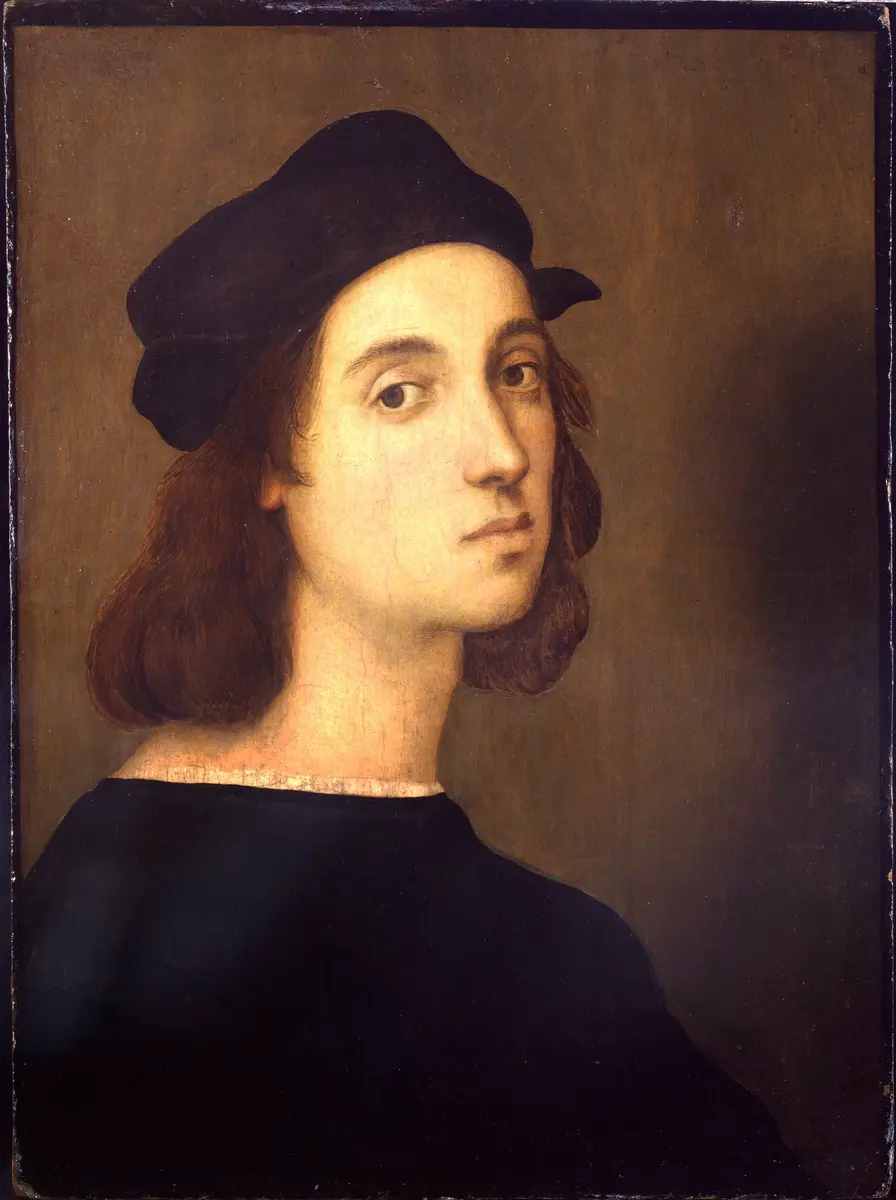
He paints his self-portrait, at about 23, in a painter's cap and working clothes.
- 1507
Atalanta Baglioni of Perugia commissions the Deposition for her family chapel in memory of her son, killed in a feud in 1500; in its bodies Raphael sets out to learn from Michelangelo.
- 1508
Toward the end of the year, aged 25, he is called to Rome by Pope Julius II on the advice of Bramante, and set to paint the pope's apartment in the Vatican, beginning with the room that served Julius as library and study, the Stanza della Segnatura.
The Raphael Rooms in the Vatican Palace: the Stanza della Segnatura (1508–11) and the rooms that followed - 1509
By now at work on the frescoes for Julius: the Disputa, the triumph of the Church, faces what will be the School of Athens.
The Raphael Rooms in the Vatican Palace: the Stanza della Segnatura (1508–11) and the rooms that followed - 1511
The Stanza della Segnatura is finished, with the School of Athens, where he paints himself at the right edge.
The Raphael Rooms in the Vatican Palace: the Stanza della Segnatura (1508–11) and the rooms that followedAbout now he paints the sea nymph Galatea in the villa of the banker Agostino Chigi, his first great work for a private patron in Rome.
- 1512
In the next room, the Room of Heliodorus, he paints the Mass at Bolsena with Julius II kneeling at the altar.
The Raphael Rooms in the Vatican Palace: the Stanza della Segnatura (1508–11) and the rooms that followedFor Julius he also paints the Sistine Madonna, for the high altar of San Sisto in Piacenza, finished in 1512 or 1513.
- 1513
Julius II having died on 21 February, the cardinals elect Giovanni de' Medici, son of Lorenzo the Magnificent, as Pope Leo X; Raphael's work for the papacy goes on and grows. This year the banker Agostino Chigi also orders from him a burial chapel in Santa Maria del Popolo.
- 1514
He finishes the Room of Heliodorus with the night scene of the Liberation of Saint Peter, and his pupils begin the third room, the Fire in the Borgo, to his designs.
The Raphael Rooms in the Vatican Palace: the Stanza della Segnatura (1508–11) and the rooms that followedBramante dies. Raphael, whom Leo X had named to work beside him that year, takes charge of the new St Peter's and turns its plan from a Greek cross into a Latin one.
- 1515
About now he paints his friend Baldassare Castiglione, the Duke of Urbino's envoy in Rome and the future author of The Book of the Courtier.
Leo X commissions the cartoons for ten tapestries of the lives of Peter and Paul for the Sistine Chapel, and puts him in charge of ancient marbles with Latin inscriptions.
- 1517
Leo X makes him commissioner of antiquities for Rome, and he draws up an archaeological map of the ancient city; with Castiglione he writes a memorandum to the pope on preserving the ruins. Cardinal Giulio de' Medici commissions the Transfiguration for Narbonne, in competition with Sebastiano del Piombo's Raising of Lazarus.
- 1518
His portrait of Leo X with two cardinals is sent to Florence for the wedding of Lorenzo de' Medici, Duke of Urbino; in Chigi's villa his workshop paints the Loggia of Cupid and Psyche to his designs.
- 1519
On Saint Stephen's Day seven of the tapestries woven in Brussels from his cartoons hang in the Sistine Chapel for the first time; Raphael probably oversees their hanging.
- 1520
He dies in Rome of a fever, on Good Friday and, by the usual account, his 37th birthday. The funeral mass is said at the Vatican with the unfinished Transfiguration at the head of his bier, and he is buried, as he had asked, in the Pantheon.
The Pantheon, Rome: his tomb