Tycho Brahe
“The Danish nobleman whose naked-eye measurements from his island observatory, the best before the telescope, showed that the heavens can change and gave Kepler the data for his laws of planetary motion.”
Tycho Brahe was a Danish nobleman who became the greatest observing astronomer before the telescope. With huge instruments of his own design, checked against each other and read with great care, he measured the positions of stars and planets to about one or two minutes of arc, far better than anyone before him, and he observed the planets night after night through their whole paths instead of only at a few special points. His measurements showed that the new star of 1572 and the comet of 1577 lay far beyond the Moon, so the heavens could change and could not be made of solid crystal spheres. His twenty years of records later let his assistant Johannes Kepler discover that the planets move in ellipses.
He was born on 14 December 1546 at Knutstorp in Scania, then part of Denmark and now in Sweden, and was brought up by a rich, childless uncle, who sent him to study law. An eclipse of the Sun in 1560 that came exactly when predicted turned him to astronomy, and at Leipzig in 1563 he found that the best tables of the planets were days or even a month wrong. He resolved to fix astronomy with better observations. In a duel at Rostock in 1566 he lost part of his nose and wore a metal replacement for the rest of his life. On 11 November 1572 he saw a brilliant new star in Cassiopeia; his little book on it, De nova stella (1573), made his name. He lived with Kirsten, a commoner he could not lawfully marry, and they had eight children.
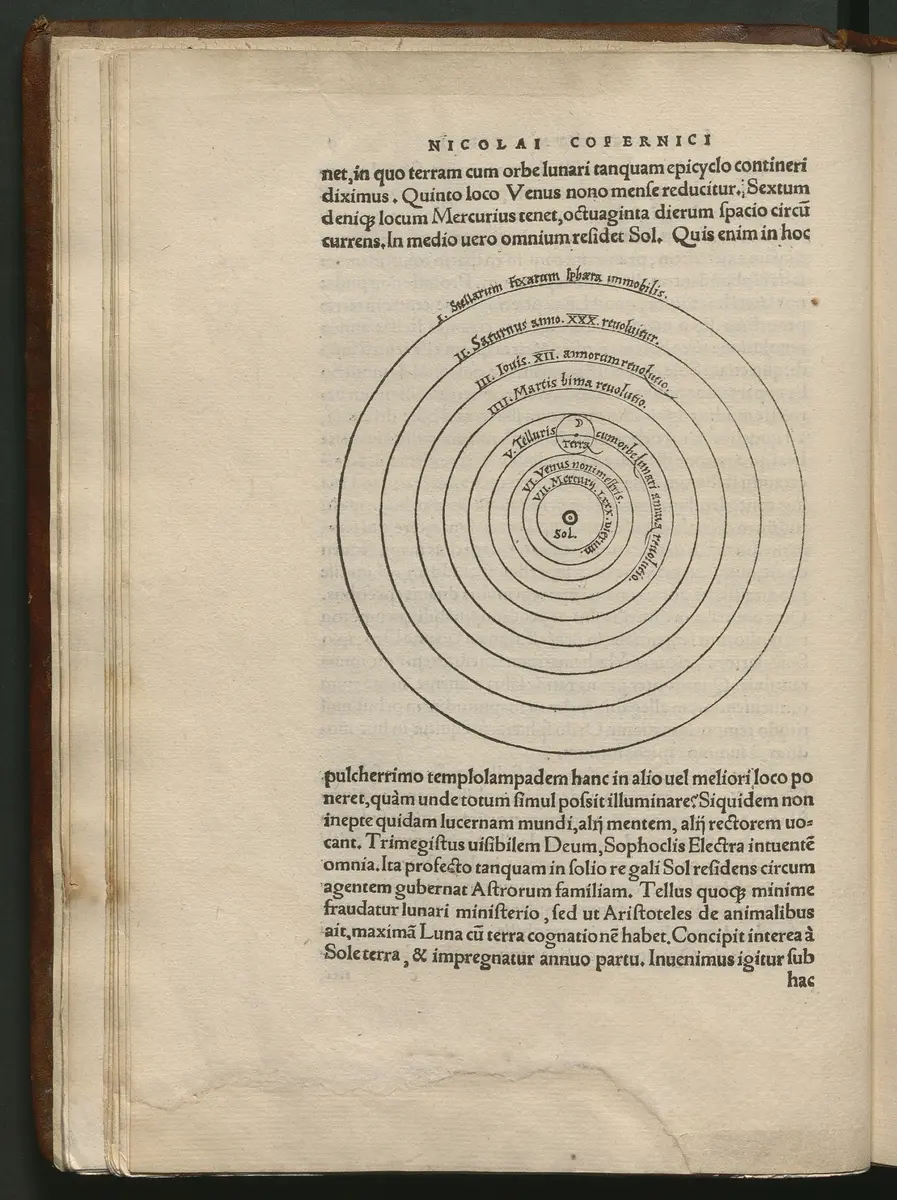
To keep him in Denmark, King Frederick II gave him the island of Hven in the Sound in 1576, with money to build. There Tycho made Uraniborg, a castle-observatory with observing rooms, a library, workshops, a printing press, a paper mill and an alchemical laboratory, and later Stjerneborg, a second observatory sunk into the ground. Many assistants were trained there, and visitors included the future James I of England. In 1588 he proposed his own system of the world: the Earth stays at rest at the centre, the Sun and Moon go round it, and the other planets go round the Sun. He could not accept a moving Earth: it clashed with the physics of his day and with Scripture, and he could find no shift (parallax) in the stars that a moving Earth should cause. Ursus published a similar scheme the same year, and the two quarrelled over who came first.
After Frederick died in 1588, Tycho, proud and demanding, lost favour with the young King Christian IV. He made his last observation on Hven on 15 March 1597 and left Denmark with his family, instruments and press, first for Rostock and then for Wandsbek near Hamburg, where he printed the illustrated book of his instruments. In 1599 Emperor Rudolf II made him Imperial Mathematician in Prague, and in February 1600 Kepler joined him at the castle of Benátky. On 13 October 1601, at a banquet, he fell ill with a blocked bladder; he died in Prague eleven days later, on 24 October 1601, aged 54, and was buried in the Týn Church. Danish dates in his life are in the old Julian calendar; from 1599 he used the new Gregorian one, as Bohemia did.
Tycho's observations passed to Kepler, who built the Rudolphine Tables (1627) and his laws of planetary motion on them; his system of the world remained the favourite of many astronomers until the middle of the seventeenth century. Stories grew around him, from the silver nose to rumours that he was poisoned. When his grave was opened in 2010, a Danish-Czech team found that he had not died of mercury poisoning, and green stains on the skull showed that the nose he was buried with was made of brass.
What happened
- 1546
Tyge (later Latinised as Tycho) Brahe is born at Knutstorp in Scania, then part of Denmark, the eldest son of the nobleman Otte Brahe and Beate Bille; his twin brother is stillborn. The date is in the Julian calendar, still used in Denmark (24 December in the Gregorian).
Knutstorp (Knudstrup), Scania: the Brahe family seat, where Tycho was born on 14 December 1546- 1548
At about two he is taken away by his childless uncle Jørgen Brahe and his wife Inger Oxe, who bring him up as their heir; his parents let it stand.
- 1559
Aged twelve, he begins his studies at the University of Copenhagen.
- 1560
An eclipse of the Sun, partial in Copenhagen, happens at the time astronomers had predicted. Amazed that the heavens could be foretold, he buys his first astronomy books.
- 1562
His uncle sends him to the University of Leipzig to study law, with a tutor, Anders Sørensen Vedel; Tycho reads astronomy in secret at night with a globe the size of a fist.
- 1563
He records his first observation, a close meeting of Jupiter and Saturn, and finds the tables wrong by about a month (the old Alfonsine tables) or by several days (the newer Copernican ones). He decides that astronomy needs better observations.
- 1565
His uncle Jørgen dies, having given his life rescuing King Frederick II; with him goes the main reason to keep Tycho at home studying law.
- 1566
In Rostock he fights a duel with a fellow Danish noble student, his third cousin Manderup Parsberg, after a quarrel said to be about mathematics, and loses part of his nose. He wears a metal piece over the gap for the rest of his life; the two later become friends.
- 1569
In Augsburg, with the help of the brothers Johann Baptist and Paul Hainzel, he has a huge wooden quadrant with a radius of about 19 feet built on Paul Hainzel's estate outside the city, and designs a portable sextant.
- 1571
His father dies. Tycho shares Knutstorp with his brother Steen but soon moves to Herrevad Abbey, the home of his uncle Steen Bille, where he builds an alchemical laboratory and a small observatory.
Herrevad Abbey, Scania: his uncle Steen Bille's house, where he had his alchemical laboratory and first saw the new star of 1572- 1572
Walking out after sunset from his laboratory, he sees a new star in Cassiopeia, brighter than Venus, where no star had been. Measured night after night, it never shifts against the stars, so it lies far beyond the Moon: the heavens, held to be unchanging, can change.
Herrevad Abbey, Scania: his uncle Steen Bille's house, where he had his alchemical laboratory and first saw the new star of 1572- 1573
His short book on the star, De nova stella, is printed in Copenhagen and makes him known across Europe. About this time he begins to live with Kirsten (Christine), a commoner; as a noble he cannot marry her lawfully, and their eight children cannot inherit his rank.
- 1574
The new star fades from sight at the end of March, after almost seventeen months. Today it is known as Tycho's supernova.
He lectures on astronomy to young noblemen at the University of Copenhagen, praising Copernicus's mathematics while rejecting a moving Earth.
- 1575
On a tour of German and Italian astronomers (Kassel, Frankfurt, Basel, Venice, Augsburg), he is at Regensburg for the crowning of the future emperor Rudolf II as King of the Romans and meets Rudolf's physician Thaddeus Hagecius, who gives him a manuscript copy of Copernicus's Commentariolus. He thinks of settling in Basel.
- 1576
To keep him in Denmark, King Frederick II offers him the island of Hven in the Sound between Copenhagen and Helsingør, with money to build an observatory.
The king signs the grant: Hven, its farms and its tenants are Tycho's for life. On the island's highest point he begins Uraniborg, 'Urania's castle', named for the muse of astronomy.
Uraniborg on the island of Hven (Ven): his castle-observatory and home from 1576 to 1597, with Stjerneborg beside itOn his thirtieth birthday he begins regular observations of the Sun at Uraniborg, the start of more than twenty years of nightly measurement.
Uraniborg on the island of Hven (Ven): his castle-observatory and home from 1576 to 1597, with Stjerneborg beside it- 1577
Just after sunset he sees a great comet, which he follows until 26 January 1578. His measurements show it has no parallax and moves among the planets, through the region where the crystal spheres of the old astronomy should be.
Uraniborg on the island of Hven (Ven): his castle-observatory and home from 1576 to 1597, with Stjerneborg beside it- 1580
Uraniborg is finished: a house with observing rooms on the upper floor, a library with his great brass globe, a fountain, and a chemical laboratory in the cellar, inside a square walled garden. Workshops, and later a printing press and a paper mill, serve the work; many young assistants are trained here.
Uraniborg on the island of Hven (Ven): his castle-observatory and home from 1576 to 1597, with Stjerneborg beside it - 1584
Short of room, he builds Stjerneborg, the 'castle of the stars', just outside the walls, with its instruments in rooms sunk into the ground away from the wind.
Uraniborg on the island of Hven (Ven): his castle-observatory and home from 1576 to 1597, with Stjerneborg beside it - 1586
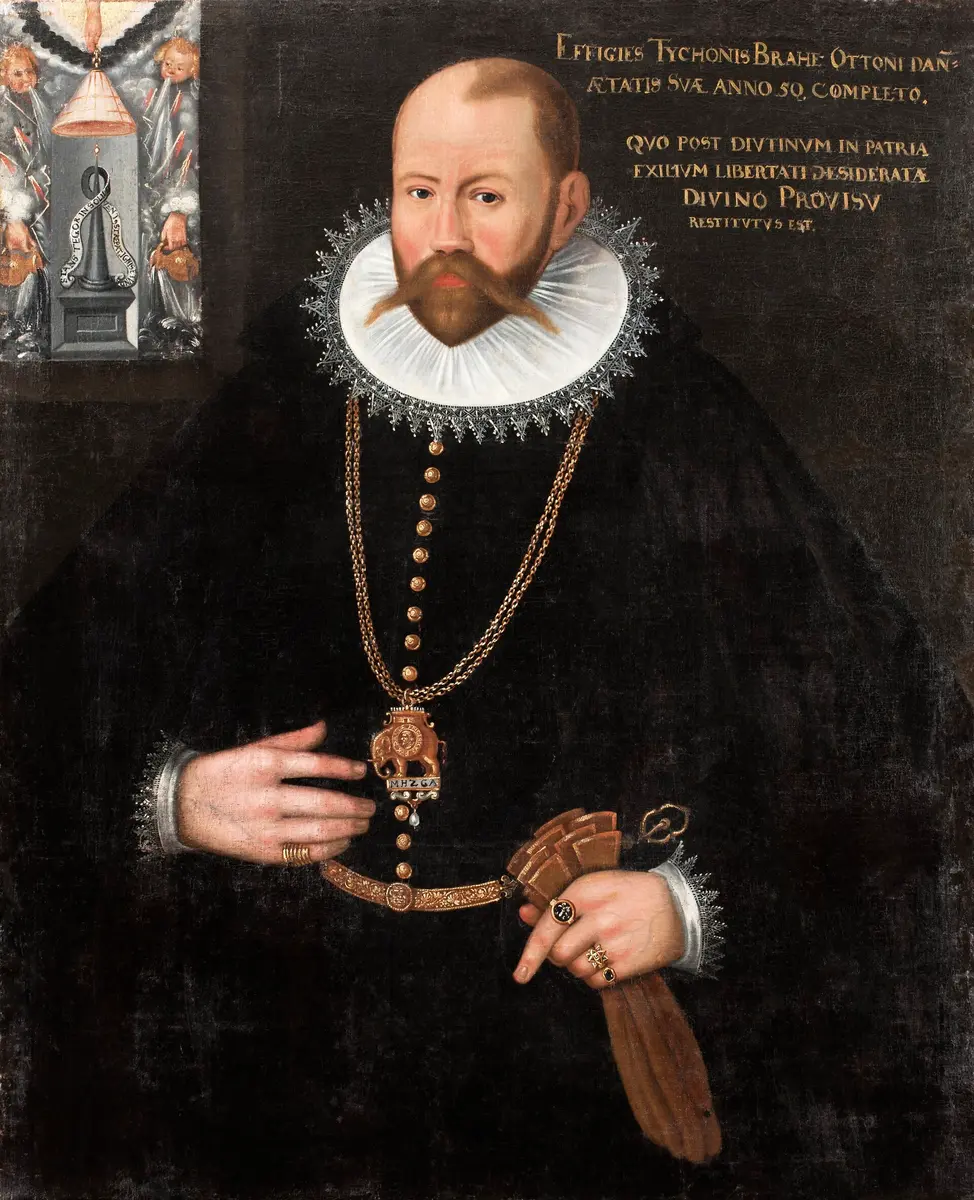
The German painter Tobias Gemperle portrays Tycho, now forty; copies of this likeness become the model for Jacques de Gheyn's engraved portrait of him.
- 1587
The wall inside the great mural quadrant is painted with a life-size picture of Tycho at work among his instruments, dated 1587 in its cartouche; the quadrant, a brass arc with a radius of about six feet, gives star altitudes to a fraction of a minute of arc.
Uraniborg on the island of Hven (Ven): his castle-observatory and home from 1576 to 1597, with Stjerneborg beside it - 1588
His book on the comet of 1577, De mundi aetherei recentioribus phaenomenis, printed on his own press at Uraniborg, sets out his own system of the world: the Earth at rest in the centre, the Sun and Moon circling it, and the other planets circling the Sun. Nicolaus Reimers Ursus publishes a similar scheme the same year, and Tycho accuses him of stealing it.
Uraniborg on the island of Hven (Ven): his castle-observatory and home from 1576 to 1597, with Stjerneborg beside itHe inscribes a copy of the new book to his assistant Gellius Sascerides; years later Gellius's engagement to Tycho's daughter Magdalene collapses in a bitter quarrel.
Uraniborg on the island of Hven (Ven): his castle-observatory and home from 1576 to 1597, with Stjerneborg beside itKing Frederick II dies. His son Christian IV is a child, and under the regency Tycho's support at court slowly weakens.
- 1590
King James VI of Scotland, later James I of England, visits Tycho on Hven.
Uraniborg on the island of Hven (Ven): his castle-observatory and home from 1576 to 1597, with Stjerneborg beside it - 1592
The young Christian IV visits Hven.
Uraniborg on the island of Hven (Ven): his castle-observatory and home from 1576 to 1597, with Stjerneborg beside it - 1596
His Epistolae astronomicae, letters on observing exchanged with Landgrave William IV of Hesse-Kassel and his astronomer Christoph Rothmann, with a description of Hven, come off the Uraniborg press.
Uraniborg on the island of Hven (Ven): his castle-observatory and home from 1576 to 1597, with Stjerneborg beside it - 1597
He makes his last recorded observation on Hven. At odds with the young king, the church and the nobility, and having neglected his tenants and the king's buildings in his charge, he has lost most of his income; he moves his family, press and smaller instruments to Copenhagen, leaving the mural quadrant and three other large instruments behind.
Uraniborg on the island of Hven (Ven): his castle-observatory and home from 1576 to 1597, with Stjerneborg beside itEarly in June he sails for Rostock with his family, assistants, instruments and press, leaving Denmark for good.
At the invitation of the nobleman Heinrich Rantzau, he settles in Rantzau's castle at Wandsbek near Hamburg and starts observing again on 21 October.
- 1598
At Wandsbek he prints Astronomiae instauratae mechanica, a lavish illustrated description of his instruments and of Hven, and sends it with a manuscript catalogue of about a thousand stars to Emperor Rudolf II, hoping for a new patron.
Assured of a welcome in Prague, he leaves Wandsbek; plague in Prague holds him in Dresden and then, from December, in Wittenberg.
- 1599
He reaches Prague, is lodged in the house of the late Vice-Chancellor Curtius and received by Rudolf II, who appoints him Imperial Mathematician. Wanting a quiet place to observe, he soon moves to the castle of Benátky, 35 km to the north-east. From this year he dates his letters in the new Gregorian calendar used in Bohemia.
Benátky castle, Bohemia: his observatory for the emperor in 1599 and 1600, where Kepler joined him- 1600
Johannes Kepler, a young Lutheran mathematician from Graz, arrives at Benátky to work with him. Mars, first given to Tycho's assistant Longomontanus, is soon handed to Kepler; the relations between the two men are often strained.
Benátky castle, Bohemia: his observatory for the emperor in 1599 and 1600, where Kepler joined himHaving moved his instruments in the summer to the emperor's Belvedere by Prague Castle, Tycho is joined in Prague by Kepler and his family; Tycho sets him to write a defence of Tycho's priority against Ursus.
Church of Our Lady before Týn, Prague: he served Rudolf II in Prague from 1599, died in the city on 24 October 1601 and is buried here- 1601
He takes possession of the Curtius house, bought for him by the emperor; the Keplers live there too. With Rudolf's support he plans new tables of the planets from his observations, to be called the Rudolphine Tables.
Church of Our Lady before Týn, Prague: he served Rudolf II in Prague from 1599, died in the city on 24 October 1601 and is buried hereAt a banquet in the palace of Peter Vok Rožmberk, too polite to leave the table before his host, he holds his urine; at home he cannot pass water, and a painful illness follows, with fever and delirium.
Church of Our Lady before Týn, Prague: he served Rudolf II in Prague from 1599, died in the city on 24 October 1601 and is buried hereTycho Brahe dies in Prague, aged 54 (Gregorian calendar), after asking Kepler to finish the tables, and repeating, Kepler wrote, 'Let me not seem to have lived in vain.' He is buried on 4 November in the Týn Church.
Church of Our Lady before Týn, Prague: he served Rudolf II in Prague from 1599, died in the city on 24 October 1601 and is buried here